Author Archives: lynnettedobberpuhl

Unknown's avatar

About lynnettedobberpuhl

I write, read, work in children and youth ministry, and try hard to be better about managing my time.

Cliché

I hate being a cliché.

It wasn’t that long ago that I would have started with the PMS stereotype, in which along with the flood of rage and raw emotion I also felt like cringing for being so predictable, but now that I am kind of cranky, bitchy and a little paranoid all the time, this stereotype is less relevant. As I tell my husband, I am now empowered to tell it like it is more than three days a month. How is that not a good thing?

A few years back, when I was trying to be a good pet owner and help my cat get some exercise, I took him out on a leash regularly. I found the experience boring. To entertain myself during the long stretches of time Cat-tabulous wanted to sniff a twig or watch a dog sleeping in a yard a block away, I brought along my crocheting. To protect my face from the sun, I wore a floppy hat. I was one ugly cat sweatshirt (okay, and maybe five cats) away from being a crazy cat lady.

Crazy Cat Lady School

Oh, I still take the cat out (#catonaleash) but now I look MUCH less crazy, scrolling along on my smartphone in a baseball cap. Yes, that IS TOO much less crazy.

In the past year I have found that I fit two new-to-me dreaded stereotypes, the 1.) out-of-touch older parent type who tries to have culturally relevant conversations with the younger generation and FAILS painfully (I managed to get Seth MacFarlane mixed up with both Seth Rogen and Seth Meyers in the SAME conversation,) and the 2.) horrifying older person who pulls out a photo of herself with a celebrity and shows it around at a family gathering, and then forgets and does it AGAIN WITH THE SAME PEOPLE AT THE NEXT GATHERING.

This is a blurry picture of Bill Nye the Science Guy and me.  Yeah, we were hanging out at the Minnesota Science Museum last November. We do that.

This is a blurry picture of Bill Nye the Science Guy and me hanging out at the Minnesota Science Museum last November. We do that.

(Note to Reader: Now that I have officially shown off to the world, I have retired that photo from my phone. You will have to return to this post to relive my brush with stardom, because I won’t be able to show it to you when I see you at the grocery store, Thanksgiving Dinner, or the cat supply warehouse.)

How many steps is it from where I am now to becoming a doddering fool? I am looking forward to the phase where I no longer care, because the sooner I start enjoying the slide, the happier my declining years will be. I picture me cackling, with many, many cats.

Out of the Comfort Zone and Into the Fire

As a nearly four year veteran of freelance article writing for Twin Cities community magazines, the idea of attending the Minnesota Magazine Mingle at The Loft Literary Center in Minneapolis was completely inside my comfort zone. I clicked on the registration link in The Loft e-newsletter and was pleasantly surprised to be directed to the Facebook page for the event. Attending? Why, thank you, yes I am.

The day of the event I took off twenty minutes early, but was still twenty minutes late due to an accident on 94W and University resulting in INSANELY backed up traffic. When I got to The Loft I discovered, at the welcome desk, that only a moron would think that accepting an invitation on Facebook would be the same as registering, and that there was, in fact, a $35 fee. On the upside, they immediately printed me a very snazzy nametag. I had heard that the event was being held in the auditorium, but another room nearby looked pretty populated and rowdy, so while I hung my coat I asked a staffer if the event was being held in both rooms. “Go in there,” she said, pointing at the auditorium. I obediently went, and spent some time looking at the amazing assortment of Minnesota-based magazines laid out for the rather sparse crowd. People noticed me, mostly because unlike them, I didn’t have a sticker on my nametag identifying me as a “writer” and/or an “editor.” I struck up a conversation with an “editor’ and “matchmaker” (someone officially charged with introducing compatible writers and editors) and learned about her work with industrial journals and newsletters for the powdercoat industry. I ate some grapes and gazed longingly at the raspberry topped brownie but strategically bypassed the salmon and dill hors d’oeuvre. Clearly, that was there as a test to see how committed we were to face-to-face networking in close quarters. I started to question what I was doing there. My community lifestyle writing didn’t seem like a big deal anymore. I drew a blank as I wondered what I could submit to various magazines representing the interests of universities, business, the History Channel, physicians, golfers, the fabric industry, or environmental sciences. I started to doubt whether I had knowledge of anything worthwhile, when I spotted a nametag for an editor of a national craft publication. I introduced myself and quickly learned (before I totally embarrassed myself) that ‘craft’ referred to, for instance, sculpture, not, say, crochet and that he was more resigned to the conversation than engaged. Because I am striving to be mentally healthy, I decided that it probably wasn’t me, that the editor was finding the whole event not that interesting. He was probably there because he had to be and the booze he was drinking was making it tolerable. I wondered where he got that booze. As a last gasp effort, I offered him my business card and he made no move to take it. “Just check our submission guidelines online,” he said. He wasn’t smiling.

When I recovered from my humiliation a bit, I met a lovely writer who seemed confused that I hadn’t gone into the other room where it turned out people had been meeting and chatting from the beginning. As people flooded from there into the auditorium, all best friends by now, she and I compared notes on editors in the room. I mentally wished her luck when she seemed interested in the craft magazine. Then, I won a door prize! Books from Loft writers and a tote bag! Sweet! Another prize winner, whose business card said Freelance Humorist was nearby. We began a conversation about blogging when a young woman walked up, told a hipster joke “Why did the hipster burn his mouth? He ate the pizza before it was cool,” and began a one-sided no-punctuation conversation about a zombie survival guide she wrote and how she thought about doing a hipster survival guide but hasn’t because she isn’t a hipster. I interrupted her to point out she wasn’t a zombie, either, but that didn’t stop her. She seemed confused by the fact I was talking, so maybe she WAS a zombie. I was trying to extricate myself politely from the conversation when I saw the last, and maybe only, editor I’d really hoped to speak to walking toward the door. I chose abruptness over etiquette but missed him anyway. I know somebody who knows somebody, so that might be fixable. I got a few more pity chats from very nice editors whose publications didn’t overlap with my skill/knowledge set, and then gave up. I grabbed a mouthful of stinky salmon dill goodness and went to sit in a comfortable chair in the hallway/lobby. I finally spied the drinks table, but was soon to be driving. I saw a big group of people chatting together, magnifying my aloneness. I thumbed a long and bitter text to a friend, then gathered my coat, and decided to go back to get a brownie for the road. At the food table, a business magazine editor appeared to be having a conversation with an intense gentleman, but within a few seconds I realized he was just listing everything he likes and dislikes about St. Paul, where it seems the editor lives. After he told her St. Paul’s cathedral is very nice but she pays too much in taxes, I decided it was imperative I find out more about her magazine. I stood there pointedly until she glanced my way and the man strode off, no doubt to make more friends. I didn’t mention him, but started what turned out to be an enjoyable conversation about her magazine and her job. I realized I was more relaxed listening and responding to what she was looking for than I am apologetically flinging my credentials into strangers’ faces, and I seemed to be making a better impression as well. She suggested we exchange cards and asked me to send her a link to some of my work. The Mingle was over.

What have we learned, kids? If it seems super easy and cheap, you are probably missing something. Don’t trust what people tell you, go where the energy is. Do your research beforehand. Most of the people out there are nice, but even so, they can’t help you if you don’t know what you are looking for. Know your questions, and make sure one of them is, “what kind of story are you excited about getting?” Most importantly, go back for the brownie.

The Wisdom of the Universe

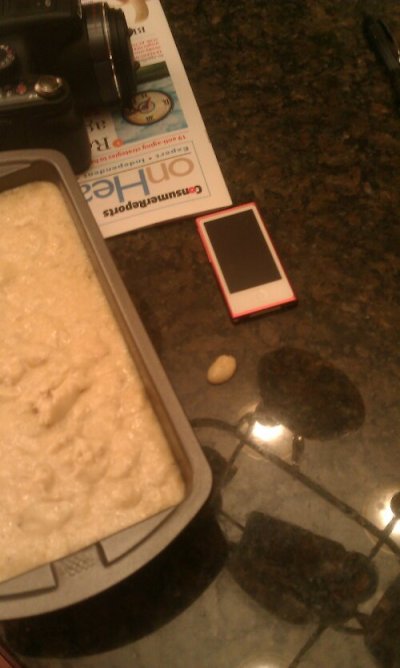
Do you see the little splootch in the middle of this picture?

image

That splootch is the universe telling me to get my head out of my ass and stop leaving my valuable and much-appreciated electronics on the counter where I am making banana bread. The universe is thoughtful that way. I was done making the banana bread, except for sprinkling pecans on top, so I totally listened. I am like the universe’s hapless child, toddling around, getting into trouble, hearing the warnings and NEVER LEARNING.

Well, sometimes I learn. I have learned that not all the bad things that happen in life are really bad things at all. Some of the best things that have happened to me seemed bad at first. Getting laid off was pretty bad, until my time was urgently needed elsewhere. Along with hosting two lovely and important family gatherings in December, I was able to spend several days with my husband’s cousin Katie. Katie, you need to know, graduated from the University of Wisconsin-Madison with honors last May. She aced her Genetics final despite a throbbing headache that turned out to be a fist-sized tumor. She had surgery, chemo and radiation and was absolutely valiant through it all despite developing seizures, gradually losing her speech and balance, and having trouble swallowing. They finally found a drug that shrunk the spreading tumors, but it was too late. She turned twenty-three last month and died last week. We are celebrating her life this Saturday, a beautiful life filled with love, laughter, travel, music, books and a very strong sense of self. A beautiful life lived well, but much too short. I don’t speculate on the whys of this. I, and everyone who knew her, just miss her and grieve that we won’t be able to watch her life unfold. Losing Katie was a bad thing to happen. But losing my job and being able to spend precious hours with her was a gift for which I am grateful. So on behalf of the universe I would like to encourage you to love others, you don’t know how long you have them. Love yourself, for you are loved. Don’t despair; bad stuff happens but good things come along too. And keep watching and listening for what the universe has to tell you.
Peace.

Coincidence?

When I was a young teen living in rural eastern South Dakota, my mom had to drive me sixty miles one way for my monthly orthodontist visits, which spanned nearly three years. Mr. Wordtabulous, also a young teen at the time, lived in western Minnesota and was driven fifty miles by his mom to the same orthodontist. It is easily within the realm of possibility that we awkwardly checked each other out in the waiting room thirty-plus years ago, long before we met in college. In 2004, we went to Italy and while we were in the small town of Vernazza, drinking wine on a cliff overlooking the Ligurian Sea, we struck up a conversation with a young American couple. Over pleasantries, we found out they were newlyweds and the bride was the daughter of our former orthodontist, roughly 4,800 miles from home.

My eighth grade English teacher read an essay I’d written about my feisty Aunt Phylis and realized that her first schoolgirl crush, twenty years before and 350 miles away,was my first cousin, Bruce.

Returning from our 2006 Germany/Austria trip, we had a short layover in Amsterdam. Standing in line to board the plane to the Minneapolis/St. Paul airport, I began chatting with the people immediately behind me and discovered they live ten miles from our house.

It sometimes seems we live in a novel, with a finite list of characters engendering unlikely connections. We don’t know what threads exist between us and that stranger in the elevator, in the other lane, or in the news story taped on the other side of the globe. I take it as a cautionary tale against smugly assuming we know how things work, and a gentle nudge from the universe to remember that we are all neighbors. What coincidence have you experienced, and what is your take?

Breaking a Trail to Parts Unknown

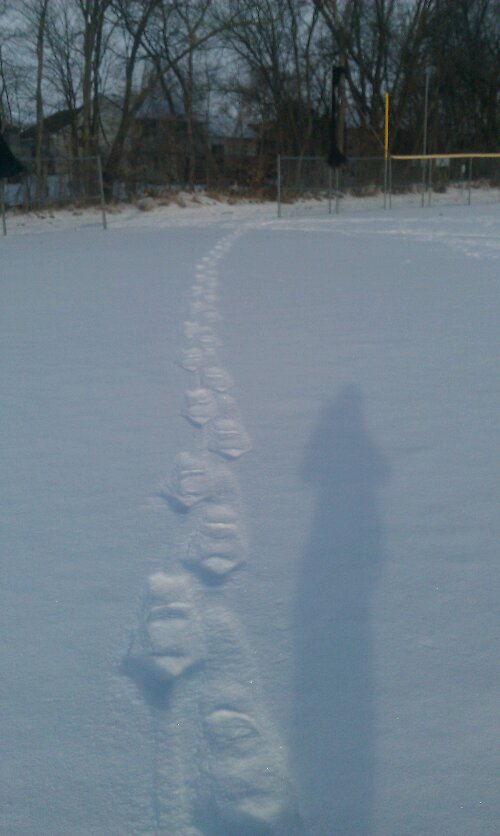
wpid-IMAG0867.jpg

This morning I pulled on my snowshoes and trudged to the park near my house. It was still and warm (in the low twenties) with sunshine that varied from comfortably diffuse to cheerfully and painfully bright. For forty minutes I dodged yellow snow by park paths, tried to find new paths through underbrush around ponds, and deliciously broke through wide, unmarked fields.

wpid-IMAG0866.jpgI laughed because it felt like I was breaking a rule—don’t trek through that pristine snow! HaHA! I broke a rule! Okay, I broke a rule that isn’t a rule and if it was a rule it would be stupid, but the paralyzing good girl craziness I struggle with lost some ground today. I was tired and thoroughly warmed up by the time I got home with forty minutes of movement behind me, two pieces of garbage I picked up along the way (this is not good girl excessiveness; litter is gross,) and a huge cramp in my right hand (what in the world?) I was warm enough to sit down on my patio and reflect on life a little. Stay tuned for an upcoming essay on how writing is like a bad boyfriend.

I may have neglected to mention that I am between jobs right now. I was…released from my schedule (?) last month when I simply ran out of things to do. With the agency change and move, my workload went from insane to nothing in three months. I am assured I will be called back as they need help, presumably with large projects, but was told “if that is too loosey goosey,” for me in terms of employment they would understand if I needed to look elsewhere. Waiting by the phone is not my thing, so I am looking, and writing…and snowshoeing. Today’s revelation is that taking a moment now and then in the fresh air has a way of helping you stay grounded, and feeling anchored makes it easier when life is changing around you. Peace.

A Bit of Fiction, and An Observation

The problem with writing science fiction in this age is that it catches up to you. I get an idea, I mull it over, I write it down, I let it ripen, I revise, I dither, and then there it is, a reality on the news. Perhaps if I cut out the dithering…Anyway, I wrote the first draft of this piece in June of 2011 and the other day on public radio I heard about this and this. Which aren’t quite what the story is about, but enough so to make what I thought were some innovative ideas look pretty ho-hum. If I didn’t know what to do with the story before when it felt edgy, I certainly don’t now. There is always a risk in sharing fiction like this, more so than just spilling commentary and images like I usually do, but I feel 2013 should be a little more about risk in the Wordtabulous domain. So here it is, first fiction in 2013. I hope you like it.

Rose Colored Lenses

by Lynnette Dobberpuhl

“Sit here,” Leone directed, glancing around the park center. Mason took a spot on the cement bench encircling a fountain, feeling burdened by the backpack she’d made him put on over his suit jacket. The sky was slightly overcast as usual, and the robust drought-loving plants sagged wearily in their planters. People hurried by alone and in couples, a few pushing strollers or walking dogs, rarely looking at each other. They were like the lackluster breeze: not fully there. Leone reached into Mason’s backpack and pulled out a folded piece of paper, a pair of eyeglasses and a brown fedora. She held them out to him.

He looked from the items to her face. “Seriously?” he asked.

“Trust me,” she urged. He studied her a moment more. Her black hair pulled back in a shellacked bun was as intense as her manner. She pierced him with blue eyes framed by black eyeglasses. He sighed. The hat was heavy, and felt tighter than it should have; there was something built into the band. The eyeglasses also felt weighty, but were perfectly clear. She handed him the sheet of paper, which looked like a normal piece of copier paper folded in half along its width. Mason looked at the blank page, then quizzically turned his gaze back to Leone. She was fiddling with an electronic tablet. “Wait,” she advised without looking at him.

Mason looked back at the paper. He heard a click and then saw a flash. His vision began to swim a bit. Small swirls of color coalesced into letters on the page, which seemed to gain weight in his hand and suddenly he was no longer holding a piece of paper, but a hardcover book. “It was the best of times; it was the worst of times,” he read. It was A Tale of Two Cities, by Charles Dickens. He concealed his surprise: the pages were thick, and turned with a rustle. They appeared to be sewn in and hand trimmed. The cover was slightly distressed leather with the title and author embossed in gold. He ran his hands over the book; it looked and felt like a beloved tome from a grand library. “Smell it,” commanded Leone. Mason pulled the book closer to his face and inhaled a familiar aged, dry papery aroma, with…was that a hint of pipe smoke? “Flip through the pages,” Mason felt the weight of the book shift in his hand as he opened it. He stopped at page 145, and read these words ‘Many a night he vaguely and unhappily wandered there, when wine had brought no transitory gladness to him; many a dreary daybreak revealed his solitary figure lingering there…’ He closed the book, hearing the snap of the cover clapping shut, feeling the whisper of air on his face as the pages came together.

“Remarkable, the new reader, is it?” He slipped the glasses off and the weight and image dissolved to reveal the paper still in his hand.

“The paper is nothing special, it’s just a prop to keep you from looking silly as you turn invisible pages,” Leone explained as she took the paper from him. “But Mason, that’s not why I brought you out here. I could have shown you that in the lab. Put the specs back on.” He complied and she fiddled again with the tablet. A movie played in front of his eyes, hovering at arm’s length. “This is kid stuff. Now this,” she said, working the tablet, “is the real thing.” The movie stopped and he heard the soft strains of a violin concerto. “Look around,” she said. As he did, Mason noted that the hazy sky had blued up somewhat, and that a few puffy clouds had formed. The flora looked greener in the better light. Altogether, the park seemed more cheerful. To his surprise the people walking by seemed to feel it, too. He detected a few soft smiles, some open gestures in conversation, unlike the usual huddled hurry. My God, he thought, is that a butterfly? With a gasp, he pulled the eyeglasses from his face and the illusion faded away. The sky was still overcast, the plants limp and tinged with gray, the sullen parade moved on as though watched by a judgmental eye. “Put those back on, you’re not done,” protested Leone. Taking a deep breath, Mason once again submitted and the music changed to a Latin beat. The bright sun beamed in a cloudless sky and flowers appeared in the hedges. A blond woman in a cheerful red dress moved down the path, swinging her hips to the beat. She smiled at him. He nudged the glasses down slightly to peer over the tops to see a pale woman in a burgundy trench coat glancing at him nervously before hurrying past. Then the music changed to death metal. Grey clouds swirled overhead and the plants around all withered. The path looked as though it was paved with crumbling gravestones. The people wore dark clothes that were slightly tattered and now seemed to move with a menacing intensity. Mason began shaking his head in disbelief.

“Hey, different strokes for different folks, right? One more thing…” Leone said, and the music switched back to the concerto. The weather cleared and Mason caught a hint of fresh cut grass on the wind. “Look around, and tell me if you notice anyone in particular,” Leone instructed. Mason looked around. The people walking past moved at the same pace, but seemed unrushed, more dignified. A mother was smiling at her child on a park bench to their right. Everyone seemed attractive but unremarkable. Then he saw her, across the path and a little to their left. An older woman was leaning against a low stone wall, doing a crossword or something on a folded newspaper. She glowed faintly, and Mason felt a surge of amiability toward her, as though she was someone pleasant he’d met briefly some time ago, except he was sure he’d never seen her before.

“Who is that?” he asked.

“That is our department head, Jane Fairbanks, and she wants to meet you,” Leone said, switching off the device. The better world faded back into the everyday and Mason stood, removing the hat and glasses. Jane Fairbanks, genuinely smiling, came over to greet him.

Back in the lab’s conference room they sipped a fortified tea-flavored beverage and ignored a plate of grayish wafers and cookies. Mason had questions: what was it called, how had they kept it a secret, how soon before the system could be streamlined and miniaturized, his head hurt; had they given him a tumor? And finally, would it work on food, adding flavor to the tasteless cookies for instance?

Fairbanks smiled at his enthusiasm. “We call it Lensis,” she said. “It has been developed entirely in-house by a small group of professionals in fields ranging from neuroscience, computer programming and engineering, and psychology, to fine art. Headaches are not uncommon at first, but there are no detectable health impacts beyond an elevated feeling of well-being. We are making in-roads on the taste issue, though it isn’t ready yet, and we have all the designs set up for a variety of streamlined systems. We are only months away from prototypes that could be worn under any type of hat or headband, or with modified eyeglasses and a slim strap that could be inserted around the back of the head and hidden under hair. Ultimately, people could have implants inserted invisibly beneath the scalp and wear contact lenses and never have a visible gadget at all. We won’t even need an external controller, because it can be operated with eye and head movements.”

“How would such a device be powered?” Mason asked, imagining a five pound battery pack implanted beneath his skin.

“Future generations can be powered wirelessly using kinetic, solar or chemical power cells.”

“Tell me more about that trick where you were shining and no one else was.”

Fairbanks smiled again. “We call that the ‘Glow.’ There will be a setting on each Lensis unit that allows users to turn on the Glow so they can be recognized by anyone else using Lensis in the area. It will build a community feeling, which we anticipating being useful in marketing.”

“And that warm, fuzzy feeling I got when I saw you all lit up?”

“That’s all part of the Glow, Mr. Mason.”

“Could the Glow be applied to objects as well? Say cars, or restaurants?”

“Mr. Mason, I understand what you are getting at, but the use of Lensis as a marketing tool could be a problem. If the public feels they are being manipulated as consumers, there will be a backlash. You remember how laughable the product placement strategy was in movies from around the turn of the century?”

“Perhaps something more subtle and understated, then?”

An inscrutable Fairbanks regarded him for a moment. “Perhaps,” she said.

Mason nodded. “So what do you need me for?”

“We have contacted you because we are out of funds. To build our next prototypes, to miniaturize the devices to a practical level, we need an investor.”

“If you want money, I need to know more about the commercial application. I can see the potential as an entertainment device…”

“Mr. Mason, consider these numbers,” Fairbanks said, sliding a dig-I button toward him. Mason applied it to his smart device and began flipping through charts and tables. “The first charts indicate the earnings potential for the system as an entertainment device alone, but look at the data preceding charts 6 & 7.” Mason skipped ahead. “Our preliminary findings show that using the system alleviates symptoms of depression. As you saw, it completely alters, one could say revolutionizes, a person’s perception of reality without altering reality itself.” She paused for emphasis. “Mr. Mason, do you have any idea how much money is spent in this country alone on medication to alleviate depression?”

“22.8 billion dollars annually,” answered Mason.

Fairbanks raised an eyebrow at his ready answer and continued, “And since Lensis is a device intended for entertainment, do you know how much time and money would be needed to help it pass through FDA loopholes?”

“Exactly zero, I believe,” Mason said.

“You believe correctly. Mr. Mason, do you represent anyone you believe might be interested in being part of the Lensis revolution?”

“I just may have someone in mind, Ms. Fairbanks.”

A few days before the Lensis release Mason returned to his grandparent’s farm with a Lensis device. He was curious to see how the effect worked on isolated places untouched by urban blight. First, he walked around the house, the old barn, the pond and the orchard and examined it all with the naked eye. He noted the peeling paint on the house, the decaying boards in the hayloft under the gap where the roof had collapsed, the overgrowth of scrub trees in the ailing orchard, but overall the pond, the yard—everything looked roughly as he’d remembered it. Then, he’d put on Lensis. The breeze had freshened, the air softening against his skin. The windowpanes glittered in the sun and his ears were filled with the buzzing of insects and frogs and the chirping of birds. An earthy, barnyard smell hinted at the animals he now remembered: a horse and two cows, and a small flock of chickens. He walked around the barn and the air became fragrant with apples hanging on the branches. A light gust rustled the grasses around the pond and he turned to look, his breath catching in his throat. Every twenty-five feet or so a blinding white egret stood sentinel around the edge of the sparkling water, watching for minnows and frogs. Those birds had fascinated him every year until one fall, decades ago, they had flown away for the winter, and never returned. He felt an odd sort of anticipation, as though at any minute someone he loved would drive up and call him to help unload groceries from the car.

He was startled when, hours later, he was pulled from his Lensis state by the beeping of his alarm, warning him he needed to leave to be back in the city for his evening meetings. His head no longer hurt after using the device, but seeing the Lensis effect evaporate to leave him in a yard full of dingy buildings and a muddy wetland brought an ache to his soul. His hand trembled on the steering column as he drove back to the city thinking, too sweet a poison and resolved never to put Lensis on again.

Edward Brandell examined his reflection in the window overlooking the city that stretched as far as the eye could see. His kingdom was spread before him, dimly illuminated with the New Conservation Approved bulbs, but he was noting the bags under his eyes. He brought the lead glass highball tumbler to his lips and savored the flavor and burn of the whiskey in his mouth, throat and gut. In a world of synthetic food and artificial flavors the real thing was worth any price. A door opened and closed quietly behind him. “Well?” he asked without turning.

Mason’s voice was tired. “We quelled the riot at the tire plant. One dead and twelve injured before we re-engaged Lensis access.”

“Re-engaged? I banned that damned system from the workplace! You can’t give in to them like that.”

“Ed, take it easy. We’ve got them on a five-minute access for every hour they are in the building. That’s huge progress. Maybe we can stretch it to five minutes for every three hours, but we are going to have to take this gradually. I swear to God, when we blocked that signal, I thought people were going to have seizures.”

“Those Lensis things aren’t even supposed to be in the building. It’s a condition of employment for Christ’s sake!”

“Well they ALL have them, and I am not exaggerating, Ed. People are hooked. Shutting them off cold turkey for eight hours will guarantee you a hell of a lot worse than some broken windows.”

“Well,” Brandell snapped, “letting them work with those things on is going to get people killed, either workers from being distracted on the factory floor, or customers driving on bad tires that looked good enough to quality control from their ‘happy place.’”

“It’s worse than that, Ed,” Mason said quietly. “The tire plant is the tip of the iceberg. The Lensis effect, which made you rich and got your candidates elected, is everywhere. We’ve got bus drivers, systems management people, doctors and teachers, hell, maybe even police officers using it at all hours, and now they wonder how they ever survived without it. Mistakes are being made, and no one notices because they are lost in feeling good. The number of people who have boycotted Lensis has dwindled to almost nothing, and the few who still are boycotting are written off as a fringe culture.”

“It’s a hell of a mess,” Brandell sighed. “What do we do?”

“Up to you. We could introduce a bug that would defeat some of the ‘feel good,’ and make it easier for people to wean themselves off, but then you are going to lose most of what you’ve gained. Society and the economy will reawaken to its slow demise.”

“That’s a cheery prospect.” Brandell took another sip of whiskey, looking at Mason’s reflection in the window. The man looked thin, he thought. “We’ll talk about it tomorrow; go get some rest. And, Mason,” he said, as Mason turned to the door.

“Yes?”

“Thanks.”

Mason sagged, then exited without reply. In his rooms a few floors down he slumped into an overstuffed armchair that looked out over the same view Brandell enjoyed above. His mind’s eye was not on the city, but turned inward to the farm that was his childhood home.

They had been horrifyingly successful. The Lensis product had sold out immediately and continued to sell out, with each new generation more profitable than the last. Suicide rates went down and the economy picked up as people worked to afford Lensis devices and then demand increased for several other products benefiting from a subtly engineered Glow. Specially built Lensis systems designed to decrease prison violence worked splendidly and soon educational applications were also developed. But by this time the problems began to surface. Claims of sexual assault became muddled with perceived consent and inaccurate rose-colored descriptions. The murder and suicide rates rose again, higher than before. Robbery also increased as those without work became desperate for resources to access Lensis states, but public outcry was absent. The world viewed through rose-colored lenses was bearable, a sanctuary removed from the disintegrating planet and unraveling future view that had been descending upon them for generations.

Groaning, Mason tore at his hair, as though by opening his skull he could exorcise the demons he himself had invited in. Then he stood and straightened his tie, smoothed his hair. In the next room, his bedroom, he opened a wall safe behind a painting of egrets. Inside, there were two items: a loaded handgun and the Lensis device. Choosing, Mason settled himself on the center of his bed. In the darkness there was a click and a flash.

Fresh

The subzero morning quiets all the noise in her head. Icy air prickles the exposed skin of her face, pecking like hungry birds, and traces stiffening paths up her nose and down her throat. Even through dark glasses, the pale dawn light on the snow is blinding. She smiles, and her teeth are chilled. One step after another, her snowshoes carry her further from the house still crowded with the memory of all the family who recently left, and the three warm sleepy bodies still there, hunkered under afghans and watching TV. That colorful space, big enough to house the numerous and sometimes conflicting conversations, agendas and activities of three generations, is a speck under the wide open sky. The only sign of life is the exhaust from furnaces swirling above the uniformly iced rooftops. There are no other people out at that hour, in that temperature; no pets in the backyards. Even sound is absent; no birdsong or distant traffic noise compete with each crunching step and wssshing stride.

Thoughts retreat as well. The parts of her brain dedicated the last ten days to executing plans, anticipating, performing and connecting, find rest as she listens for rhythm in her gait and breath. Flat frozen ponds encircled by the hash mark geometry of dormant grasses offset the dark sinuous curves of the oak, maple and ash trees. The landscape is a balm needing no watchful study or tending. All the bits and pieces she had given of herself gradually return and by the time she is exhausted, leaving the last of her energy on the trail back home, she is whole again. A new beginning.

Photo_122710_001

Yes, There is Such a Thing as Too Far

I like to think I have a sense of humor. My kids would probably disagree. Mr. Wordtabulous gives me props for being funny, but usually not when I am trying to be. Still, I have my own humorous take on things and for the most part that serves me well enough. The one area where I fully admit to NO sense of humor AT ALL would be the area of practical jokes. I have made it very clear to Mr. W, and am now making it clear to you as well, that if I ever get “Punk’d” the person punking me and Ashton Kutcher will be eating a camera. Each. There would be lawsuits and probably jail time, but mark it, that would be the straw that would break this well-behaved, good sport, camel’s back. Word. Are we clear? Good.

So now I am reflecting on the debacle with the New Zealand radio show hosts calling Princess Kate Middleton’s hospital staff and the horrific turn this tale has taken. If you are not up to clicking to nbc.com for the story, and don’t know what all has gone down, here it is as I understand it: Princess Kate was hospitalized for severe morning sickness during a pregnancy which has galvanized the UK, and as a joke the hosts of a New Zealand radio show called the hospital pretending to be Prince Charles and Queen Elizabeth and asking for information and to speak with Kate. The nurse who spoke with them, Jacintha Saldanha, actually gave them some information and transferred them through even though the hosts were not convincing at all. There was a huge uproar over this and the hosts claimed they never expected the prank to work, which I find completely plausible, but the upshot was that nurse looked like an incompetent idiot. Reportedly, this woman who fell for the prank, a wife and mother of two, has now taken her life. In response, the radio hosts have been fired and the station has lost advertisers. Today, The Onion tweeted, “The other nurse thought it was funny.”

Normally I enjoy The Onion, but this was gross. Irreverence is one thing, but this is NOT FUNNY. The problem with many practical jokes is the unknown quantity; the mental state of the people involved. PEOPLE. Not cast members with scripts, who go in knowing they are being compensated for playing the loser, and are glad to do it. Real unsuspecting people who make mistakes and have problems. Maybe they have long-standing issues of inferiority, or addiction issues, or are facing loss and grief. Maybe you don’t have to have a ton of issues to hate life when your entire country turns on you. Now, I don’t believe anyone suspected suicide was a possible outcome when this gag was put to play, but I also think a certain lack of empathy is a job requirement for the industry. Do I think the radio show hosts should have been fired? Maybe not, but I have trouble caring about their situation. There are probably worse characters in this sad story scapegoating the clever and amusing radio personalities. There are much worse characters at The Onion, making a joke out of the dead woman’s extreme response and putting it out into the world to provoke a ripple of mockery. Killing yourself, even when faced with what seems like universal condemnation and ridicule, is an unreasonable response. So would be forcing some self-satisfied jerk to eat a camera, yet I still can’t see why people insist upon provoking these kind of reactions.


The Dark Christmas Night of My Soul

I think this picture was taken to commemorate my new faux fur parka. Toasty and stylish.

I think this picture was taken to commemorate my new faux fur parka. Toasty and stylish.

The Christmas I remember most takes me back to the age of eight. It had been a night of traditions: Dad’s last-minute dash to our small downtown to do his shopping, Mom cooking chili and oyster stew and baking bread for our annual Christmas Eve meal. We dressed up for dinner because soon after clearing the table it was time to go to the service at church, where we sang the best of the hymns and heard again the Nativity story, recently relived through the children’s Christmas pageant in which I was an angel or a shepherd or a twinkling chorus star. At the end of the service the lights were turned off and we all passed flame from candle to candle. Children, fire and hot dripping wax in church–what could go wrong? The yearly case of slightly burned fingers was part of the fun.

Upon returning home it always seemed our tree had shrunk and the beautiful decorations, so big and colorful during the day were thinned and muted in Christmas Eve darkness. Over-tired and over-stimulated, we got ready for bed. My older sister, age 15, had a bedroom on the lower level of our split-entry house. It seemed so remote as to almost be a separate apartment although it was directly beneath my own room. My room snuggled in a corner between my little sister’s room and my parents’. I climbed into my bed that night, determined to get to sleep quickly and not risk being awake when Santa came. Songs like “I Saw Mommy Kissing Santa Claus” were all very well, but I had an unsettling notion that really seeing Santa would be Breaking The Rules and could wreck it all.

I have no idea what time I suddenly awoke in the middle of the night, sweaty, hysterical and convinced that Santa had not come, that he had forgotten us, or worse, had skipped us and it was somehow all my fault. Summoning my nerve, I crept out of bed and down the dark hallway into our living room, which seemed cavernous. Our tree was in shadows on the opposite end of the room, and I was afraid to go near or turn on the lights, but it seemed to me that there were no more shapes beneath the tree than there had been and the stockings hung on the wall looked pretty flat, too. Afraid to wake up my parents, but dancing around the edge of a full-blown panic, I woke my five year old sister and dragged her to my room. I didn’t WANT to upset her but I could not stand to be alone, and anyway, she was going to find out that Christmas was ruined soon enough. We were both sobbing by the time our mom came to see what in the world was the matter. I explained. She told us to stay in my bed while she checked things out.

We waited in agony–forever. I think part of me is still there. Everything was just so unprecedented and wrong…and yet we hoped. We hoped that I was mistaken. We hoped there had been a miracle and things were actually okay. We feared the worst. Finally, Mom returned, bearing our stuffed stockings: proof. Peeking out of the top of each stocking was a large-eared stuffed mouse stitched together out of paisley and solid polyester fabrics, purple for me and yellow for my sister. The relief was indescribable. Mom let us root through the rest of our stocking and while that also felt wrong, we did it anyway. Each item was evidence that Christmas wasn’t broken. If later we were a little sad to miss the stocking part of the morning gift tradition, even then I knew it had been a small price to pay.

That was probably the last Christmas I really believed in Santa, although since then uncertainty, panic and shame certainly have taken his place in my annual traditions. It is hard to know how to put on a Christmas full of hope and celebration when I get so worked up and worried. Putting away impossible expectations would be a start, as well as remembering the gifts that matter the most. I can’t tell you what else I got that Christmas nearly forty years ago, but that improbably colored mouse will always remind me of the first time I remember receiving grace.

Not THE mouse, but you get the idea. This is a kit for sale on etsy: http://www.etsy.com/listing/83091064/coupon-code-doll-making-kit-knitted