Category Archives: Good Behavior

A Love Letter to Discover

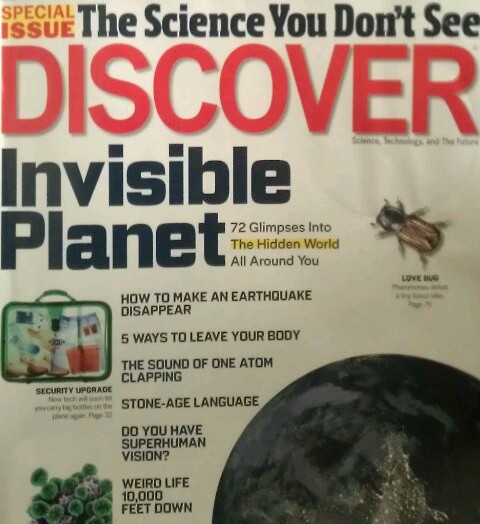
Discover magazine, how do I love thee? I love thee a lot. Even when I don’t understand thee, I love thee. I recently received the July/August issue of Discover, which appears to be very biology-centric. This makes me happy because biology is like the hot boyfriend with a little bit of an accent and colloquialisms that make communication somewhat difficult, as compared to the gorgeous boyfriend of physics who speaks a completely different language but I don’t even care, I could just lustfully listen to him spout incomprehensibility all day. Science turns me on, yo. I have been a subscriber for years and even though I haven’t lately been able to read every issue cover-to-cover, I do try. I have gotten ideas for stories and plot twists as well as general information and entertainment from the magazine and it makes me feel better than reading People magazine does. Kind of like when I choose to eat an apple over a doughnut. As Bill Nye says, “Science rules!”

So far two articles in this issue have gotten me excited. The first, “Superhuman Vision” is about a mutant cone some women (maybe a lot of women) are carrying around, a fourth cone that allows them to see an exponential number of color variations not visible to other humans. It is kind of like the Bizarro World version of the green/red color blindness that diminishes color perception in some men. How cool is that?! Mutant powers! X-(wo)men! The thing is that many of these women probably aren’t aware that they are seeing anything the rest of us aren’t because the nature of perception is so individual. Imagine trying to describe red to someone who can’t see red or provoke someone who doesn’t taste chocolate or tobacco in their red wine to do so. Difficult. I want them to make the test they describe in the article available on the internet. Maybe I have super vision! Actually I suspect that the only thing special about my vision is the degree to which I am frazzled by floaters, which isn’t very special at all.

The other article was “Earth’s Last Unexplored Wilderness Is…Your Living Room.” I love articles which immediately make me change my behavior. I wasn’t even halfway through the piece when I jumped up and opened all the windows on the main level of my house. For fifteen minutes–until the heat and humidity (already? at 8:30 a.m.?) forced me to close them again. Now, science reveals some uncomfortable truths, that maybe not all of you want to know. Far be it for me to expose you to graphic information that could gross you out for life, so two things: you might want to disinfect your showerheads, and wash your pillowcases with bleach in the hottest water you can. As I am. That is all.

It isn’t like Discover has never led me astray. I preached the anti-high fructose corn syrup gospel for over a year based on a quoted scientist who described it as a “metabolic disaster.” Further study showed no such thing, of course. Sugar is sugar, and we are getting way too much in all of its forms. But that is part of what I like about science. People make hypotheses and test them and share the results and other people say, “Hey, that is interesting! Are you sure?” and re-test the results, using what comes to leap to more evolved hypotheses, and we are all better for it. We grow from knowledge and experience. Ideally, science is all about open-mindedness, and using evidence to guide us toward knowledge. Some also use the lack of evidence to deny the existence of things for which we cannot test, like God for instance. In earlier generations, the existence of germs and sub-atomic particles and dark matter was considered ludicrous. I wonder what fascinating things we will know for certain in the future that are unimaginable to us today? I can’t wait to read about them in Discover.

Three Random Things

My work adventure this past week became a family affair. Our newest client had a big event which will occur in Brooklyn, NY on Tuesday and they needed 850 drawstring backpacks to be stuffed with a summer skills workbook, ruler and pencil. These backpacks had to be counted and sorted by grade level (as the workbooks varied,) and there were two sets of thirty backpacks that needed slightly different contents. Nearly everything needed to assemble the backpacks arrived on Friday. I did the setting up and called in my teenage boys to do most of the stuffing, which took them four and a half hours (with my support.) Then, because we finished too late to ship that night, they and Mr. Wortabulous took an hour of their Saturday morning to help me get nineteen boxes to the post office. Seventeen of those boxes weighed between 50-55 pounds each. The other two were a little lighter. We express shipped them all to arrive in Brooklyn on Monday. This impresses me so much. 900 pounds of stuff leaves a Minnesota post office on noon on Saturday and arrives intact at a Brooklyn school on Monday. Hopefully. Really, really hoping. Trying to let go.

Friday’s staging for the Great Backpack Stuff-a-palooza.

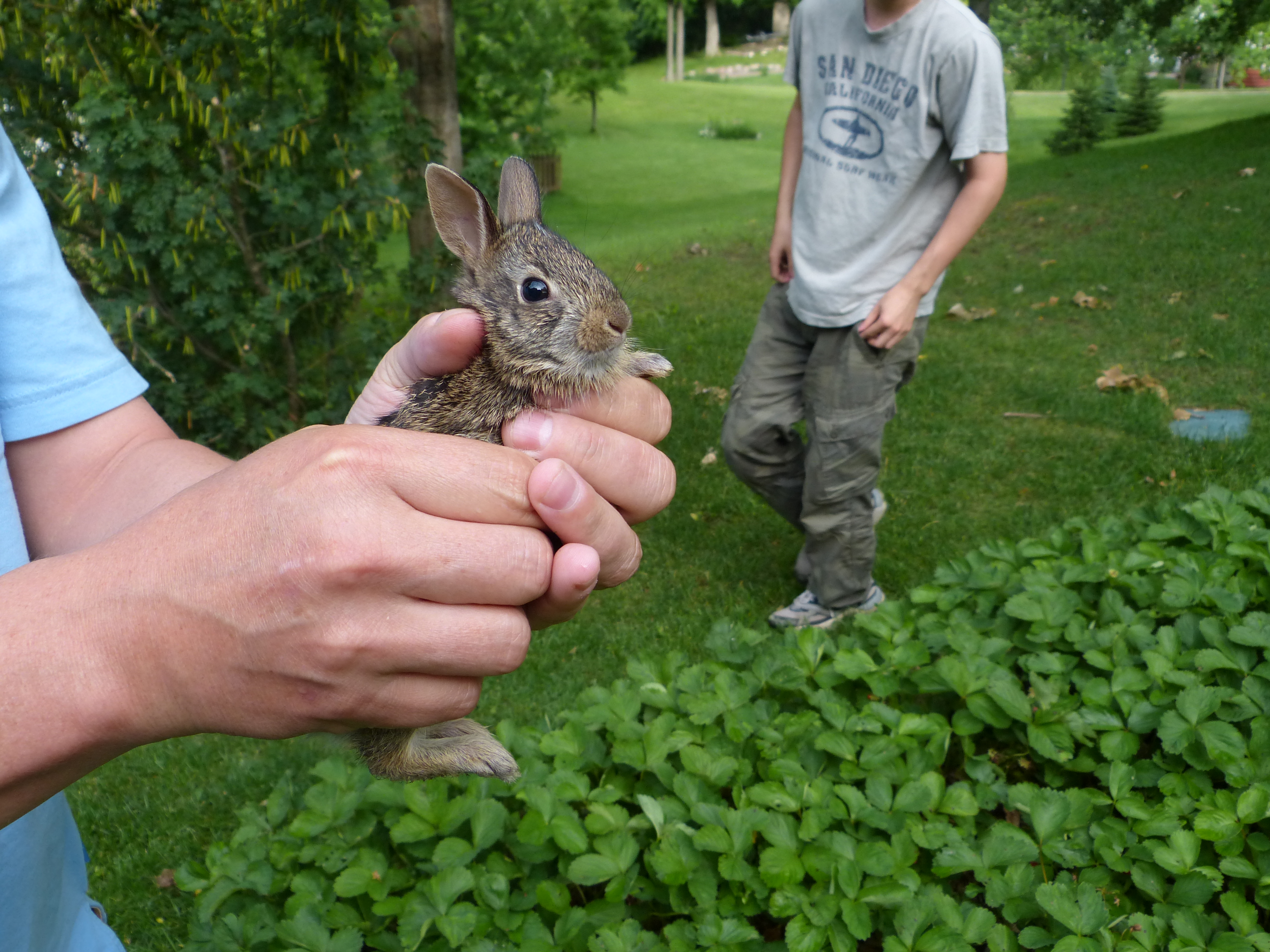
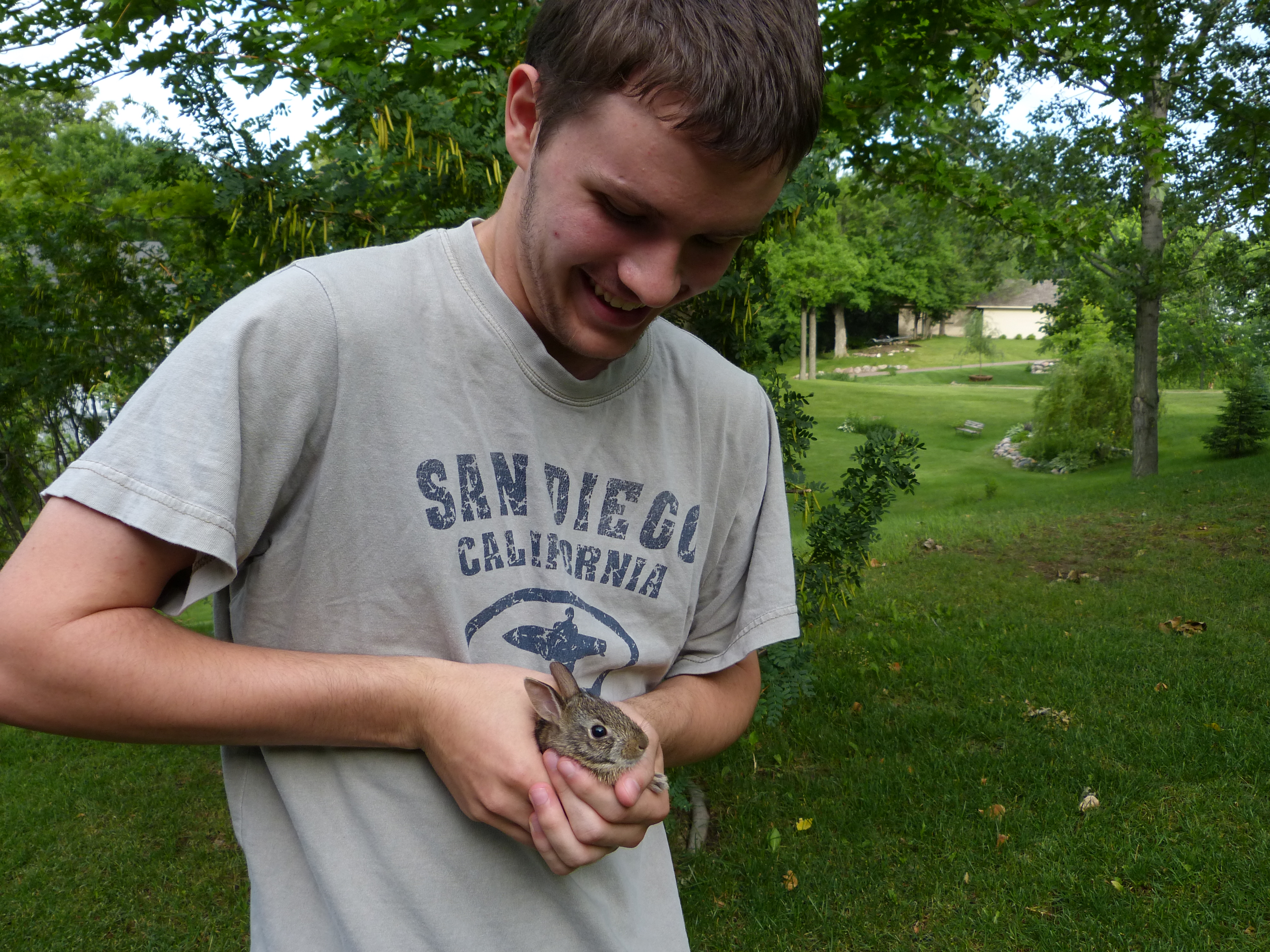
In honor of Father’s Day I would like to thank Mr. Wordtabulous for being a great dad and husband. He discovered a small rabbit lurking in our strawberry bed today and called out our older son (who loves animals devotedly and had told us he had seen a bunny in the yard earlier; since he rarely speaks in sentences, at least to us, this was notable.) Older son came out and the two of them captured the rabbit. Before the little fuzzball managed to scramble away, there was a bit of bonding going on in the garden.


Finally, I was in the car listening to Minnesota Public Radio on Tuesday when I heard that Ray Bradbury died. I read my favorite of his, Something Wicked This Way Comes, for the third time recently so in honor of the man I read my friend Kelly’s fave, The Illustrated Man. In the introduction, Bradbury writes: What I am trying to say is that the creative process is much like the old-fashioned way of taking photos with a huge camera and you horsing around under a black  cloth seeking pictures in the dark. The subjects might not have stood still. There might have been too much light. Or not enough. One can only fumble, but fumble quickly, hoping for a developed snap…My tunes and numbers are here. They have filled my years, the years when I refused to die. And in order to do that I wrote, I wrote, I wrote, at noon or 3:00 a.m. So as not to be dead. Here’s to you Ray Bradbury, and your legacy which will endure.

It’s OK, Red Rider. You Can Take a Break Now.

Saturday, June 2 was a beautiful day in Minnesota. In fact, it was absolutely breathtaking, which made it so much easier to get up early, load up the cycling accoutrements and head off to Minnehaha Falls Park to ride, party and kick diabetes’ ass.

Last year, I rode with a team I didn’t know very well. I met up with teammates at one rest stop and at the end. I raised $500 dollars. I was really impressed with the ride, the organization and the people involved. I loved how, every time I passed or was passed by someone wearing a red jersey that said “I Ride With Diabetes” we all called out “Go, Red Rider!” I knew I wanted to ride the Tour again but also knew after trying the 64 mile route I needed to either train more or ride less distance for full happiness.

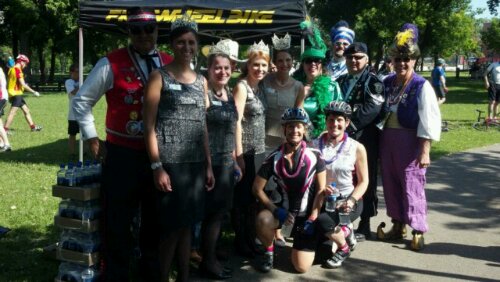
This year, I had my own team of seven people (including two Red Riders.) I rode with one of my teammates and used my phone and texts to stay in touch with everyone else. Three of my teammates were brand new to the event. I only had one teammate who got sick and was unable to ride, but all of us raised at least the minimum and we surpassed our fundraising goal. I rode 45 miles and instead of making conversation with total strangers as I did last year, (which was cool in its own way) I got to reconnect with the friend who rode with me. We had an excellent ride and were pleased with our route choice, which was long enough to be a challenge (since once again I hardly trained at all) but not so long as to give me a screaming migraine, which unfortunately sometimes happens. We hit all last year’s great landmarks: Lake Harriet and Lake Calhoun, the Target Center and the Stone Arch Bridge, the Greenway, Grand and Summit Avenues, the Cathedral of St.Paul, Kellogg Ave, Harriet Island, Fort Snelling and back to Minnehaha Falls. We took advantage of the rest stops when we felt like it. At one stop, we took the opportunity to get our photo taken with the Winter Carnival royalty who were very colorful and friendly. And, right to the finish line, we called out “Go, Red Rider!” as the occasion arose, which really helps a person stay focused on the cause.

Yes, we are wearing leis. You DON’T wear a lei when you ride a bike? Weird.

Once we were done, we got together with as many of our teammates as we could gather; one needed to leave early and one we had difficulty connecting with due to phone issues. We got our free lunch (I had a turkey burger and chips and a Zevia, which is a zero calorie fruit-flavored carbonated beverage naturally sweetened with stevia) and there was free beer (thank you Schell!) for drinkers 21 years and older.

A word about beer. I don’t LOVE beer, but there are situations that call for it: baseball games, German food, and post ride. Especially that last one; beer is like a post-cycling miracle beverage.

We got a picture of the four of us that convened at the beer garden. I am so proud of everyone on my team, for saying yes to the event and and supporting the American Diabetes Association, and am so honored they chose to sign up with my team! I only wish I had a shot of all of us together plus all our fabulous friends and family who donated to support our efforts, but their faces are all engraved on my heart.

Don’t we look happy? Wouldn’t you like to ride with us? I don’t know who that guy in the black T-shirt is, but I think he wants to join our team!

Even BEFORE drinking the beer, we agreed we all would be riding the Tour de Cure again and–even better–one might start his own team, and recruit friends to start more teams! The only downside of the day would have to be the fact that I was forced to face the fact that I am definitely not as strong as I once was. The ride itself was great, but I was a limp rag the entire rest of the day, when in the past, I think I would have been fine. Maybe a little tired. I think the “repetitive nap attack” might be blamed a little bit on the midday beer, but the truth is that I really need to get back to the workouts.

One additional upside to the day was that I got to try out a new toy! Thank you, Verizon Wireless, for the loan of the MOTOROLA MOTOACTV! I will have a review of the device later this week. I will be using it to jump start my enthusiasm for additional workouts. I CAN tell you that by mile 28 of yesterday’s ride, I had burned an estimated 1,073 calories. Sadly, due to user inexperience, the unit’s battery died at that point, so I am not sure how many calories total I burned. Still, exciting!

Thanks for hanging in there with me through this report of Tour de Cure 2012. Eat right, exercise, and send your pancreas positive thoughts so diabetes doesn’t darken your door, and if it does (or already has,) know that there are thousands of people out there pedaling for you and for a cure!

I’ve Got a Ticket To Ride!

  Yesterday I picked up my packet and dropped off my waiver and now I am bona fide (did you hear that in the voice of Holly Hunter in “Oh Brother, Where Art Thou?) This weekend I will be riding the 2012 Minneapolis Tour de Cure for the American Diabetes Association. I rounded up six awesome friends, we each rounded up donations from other awesome friends and Saturday we will live the event’s motto: “Ride. Party. Stop Diabetes.”

Some of us will ride the 18 mile route (with the option to jump to 27 miles if so inspired.) Some of us will ride the 45 mile route. Some of us are riding this event for the first time. For some, this is their first organized ride ever. There will be plenty of hard-core cyclists at the Tour, but we aren’t them.

I’ve met everyone on my team, and ridden with most of them, but there will be plenty of introductions made Saturday morning, since most of them will be be new to one another. We aren’t a close-knit friend or family or corporate team, although there will be plenty of those riding Saturday morning as well.

We aren’t world-class advocates or philanthropists. What we are is a group of everyday people drawn together by the promise of a well-organized and supported event and the hope that we can do a little something about a big problem. We aren’t heroes, except for the fact that by saying yes to a pretty minimal bit of time and effort, we have collectively raised over $2,000 dollars so far for research, education and patient advocacy, more than twice our goal and 100% more than we would have done if we’d said, “Maybe next year.” Two men on our team are “Red Riders” which means they’ll be wearing spiffy red jerseys to indicate they ride with diabetes while the rest of us (like almost everyone else in this country) have friends or family members with either the Type 1 or Type 2 diagnosis. We all want to make a difference; committing ourselves to the effort brings us one step closer to actually doing that.

Share with us one of the ways you give your time, money or sweat to make a difference!

Related Post: Warriors on Wheels: Cynthia Zuber

Related Post: Tour de Cure: The Finish Line

What’s Cooking?

Writing is like cooking. It looks so easy and fun when somebody else is doing it, but is a total freaking mess and full of traps when I go at it on my own. Reading a book primes my literary pump the same way watching a cooking show gets me thinking “chef’s hat,” inspiring all kinds of confidence and energy because I see the beautifully produced final product, not the labor, the re-writes or the re-takes (when the plot twist or souffle implodes.) By the time I start bleeding, because knives and other sharp  utensils really aren’t my thing, or by the time I am painfully knotted in a narrative thread, it is too late to completely turn back. Sure, I could toss the mess in the garbage, clean off the countertops and call for pizza. I could close without saving and pull out a new book to read. But the ghost of the unfinished dish or story will haunt me, prodding me to try again. “Come back!!” it will wail in a ghostly voice, and, my friends, I need no more voices in my head telling me to do anything. It is noisy and crowded in there as it is. When I see it through to the end, even if I don’t particularly care for the result (and my assorted Philistines have nothing favorable to say,) I can still feel some satisfaction, or at least humorous resignation toward the experience. Maybe it wasn’t a success, but it was progress.

Writing, cooking, academic performance, or even living: it is harder than it looks. Obstacles arise. Natural ability only takes you so far and the rest is work and perseverance. Sigh. Now if you’ll excuse me, I have a mess in my kitchen I need to attend to.

Blowing Off The Cobwebs

Spring is skipping happily toward summer, and I have finally gotten my bike out on the road. Both my bikes, actually. There was a rough patch in my life, following the birth of my second child and lasting for several years, during which I felt I was losing large parts of my identity as an individual. I loved my family, and loved my job (until I didn’t, when I stopped,) but I felt a little lost in the mix. I needed something fun that was just mine, and I remembered loving the wind on my face as I coasted down hills as a child. I bought a Raleigh bike with medium nubby tires, a cushy saddle and a straight handlebar. Something happened as I mounted the bike and pedaled off with no destination in mind. My focus on meeting others’ needs evaporated, with no one needy around. My preoccupation with concerns and to-do lists lifted. I could feel my blood coursing through my veins, practically singing, and I felt like I had come home.

I met Linda, a lovely woman from church, and we started to ride together. She had a road bike, built for higher speeds on paved roads and coaxed me into longer distances. She was the one who persuaded me to sign up for my first-ever organized ride: The Ironman Bicycle Classic in Lakeville, MN, so named because it offers distances of up to 100 miles in the early spring before anyone here is fully ready for long distances and because sometimes participants ride in snow, not because of any relationship with the Ironman Triathlon. Linda and I rode the 62 mile course in 1999, and I was hooked. She moved away, but I found an outdoor cycling group through the local fitness center. I bought a road bike, a Univega Modo Vincere. I eventually began organizing the group and teaching indoor cycling classes. I rode in recreational and fundraising events (including a few centuries, or 100 mile rides,) and even competed in a few events.

Then I turned, or re-turned to writing, and while I have never lost my love for cycling, it has become less and less a part of my life.  Now I ride one fundraising event a year, the Tour de Cure for the American Diabetes Association, and a handful of rides with others or by myself each season. And this is the thing: getting back in the saddle is still like coming home. When I am in a bad mood or mentally blocked, pedaling 10, 15 or 20 miles in the fresh air blows off the cobwebs, bringing me clarity and inspiration. Nowadays I ride a Specialized Allez Comp, but I still get that Raleigh out once in awhile. Chasing speed and distance is a thing of my past, but I hope I never fail to find myself, when I am feeling a little lost, out there on the open road.

How or where do YOU find yourself, when you have felt the grind of life eroding away who you are?

Related post: Cyclists: Smug But Balanced

Related Post: The Finish Line

To Err is Human, to Post is Feline.

In 2002, when I read the writing on the wall, I knew one of two things was going to happen. Either I was going to drive my growing sons crazy chasing after them and wailing, “Hug me! Why won’t you cuddle anymore?” or I was going to get a kitten and transfer all my neediness onto it. No-brainer. Mr. Wordtabulous has always been miffed that he was not consulted, only informed of the cat acquisition, but to my memory I have only brought three major things into our home without discussing it with him: garage sale dining room table (epic win,) garage sale loveseat/hide-a-bed (epic fail) and Catabulous (epic win, with allowances for noise, midnight bed stomping and litterbox maintenance.)

Having neglected my blog lately, I was racking my brain for a topic to post on (yes, preposition, I know) and all I could think of was how adorable my cat is. One of my simple but guilty pleasures is looking at pictures and videos of cats online. They are funny, and often beautiful, and sweet. I like how people caption the photos. I am amused when people dress their cats, although that is going a bit far. The thing is, people LOVE cat pics and they get a LOT of hits. So “Cynical me” posed a question to “Deer-In-The-Headlights me” (she is my default–the one who is wandering around taking everything in and hoping to make sense of it all before the screeching crash.)

Cynical: Would you ever write a cat blog?

DITH: What do you mean, like a single post, or a whole, like, themed blog?

Cynical: Don’t play coy with me. Would you ever start a blog strictly around cat images, cat care, and cat love? Just to get the hits?

DITH: Let me think. I do really love my cat. If I did start such a blog, it wouldn’t be just for the hits.

Cynical: Oh, please.

DITH: Stop it. I don’t think I have enough material.

Cynical: That isn’t an answer. And seriously? About a fourth of your posts have something to do with a cat anyway. You aren’t far off from being a cat blog. As for material, what did you just buy?

DITH: A leash. For my cat.

Cynical: And if we looked in your photo gallery on your phone, what would we find?

DITH: Cat photos…lots of them. But he’s very photogenic! And everyone else I take pictures of look like they’re in pain!

Cynical: So you have the material, you have the obsessive interest, and you have the attention-seeking personality that would dangle tags like “cat,” “cute,” “funny,” and “playful,” with the objective of luring people in just to raise your stats. Why don’t you start taking pictures of your cat next to photos of movie stars, or of him watching trailers of new release movies so you can work those into your tags, too?

DITH: I don’t like your tone. And I don’t think people who write cat blogs are only interested in hits, they are sharing the joy of cats.

Cynical: Now you are just pandering to the cat bloggers.

DITH: Wow, you’re mean. Look, the answer is no. I wouldn’t write a cat blog just for the hits. Also, I don’t have the attention span for a single topic and I lack commitment. That is why my blog is the whack-a-doodle mishmash that it is. I write what I want to (yes, yes, PREPOSITION.) Besides, if I were really cynical, I’d write about Walk Off the Earth T-shirts and local news anchors because according to my stats THAT is where the action is.

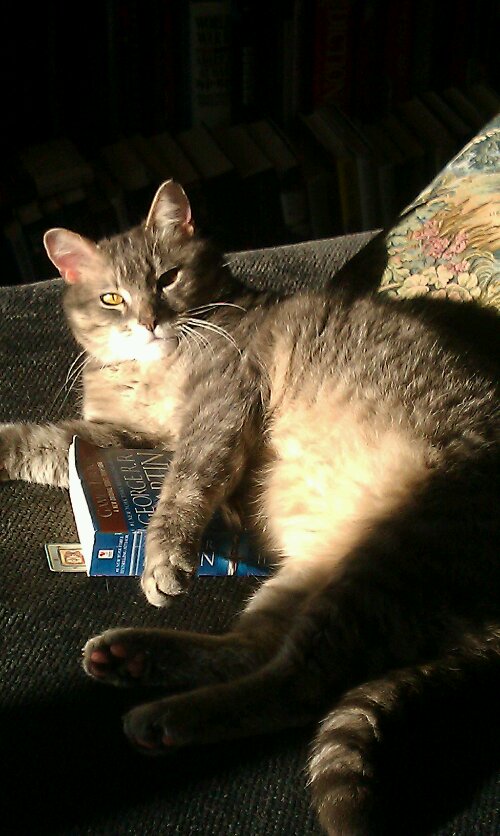
That being said, here is a funny picture of my cat sitting on top of the novel A Game of Thrones by George R. R. Martin. If only he was wearing my WOTE t-shirt and sitting on Leah McLean’s (from KSTP) lap.

Speaking of Poe,

Okay, we weren’t speaking of Poe, but after my last post and my rather self-conscious reference to “the feather light caress of mortality’s scythe,” I have been thinking about him. Like a lot of people, I hit a patch in my tween and teen years when I read a lot of Edgar Allen Poe and other authors who made the macabre an art form. I would probably have been at least a little bit goth, had there been such a thing in those days. I have never fully emerged from that patch; part of me loves the dark side, though I’d rather read it than watch it and prefer suspense to blood and gore. (Side Note: my friend Darlington tells me that in his culture–Rwanda, but in other areas in Africa as well–people love Hollywood movies but cannot comprehend our love of the horror genre. I suspect that if we faced real possibilities of genocide, murderous insurgency, and death by famine and epidemic we would enjoy horror flicks less also.)

So in reflecting how Grandma Marian’s death affected me, I was struck by how my response to death has changed as I’ve aged. Experiencing the loss of my own grandparents as a child, death seemed harsh but unimaginably distant. When one of my schoolmates died of a hidden heart defect we all grieved, but it still seemed the greatest of improbabilities, a one-in-a-million long shot, a lightning strike. Later, I lost a friend to breast cancer and then more and more people, not that much older than me, seemed to be coming out of the woodwork with life-threatening diagnoses and fatal tragedies. I lost my father to a car accident, one friend to an aneurysm and another to a drunk driver, my best friend’s mom and my husband’s mom died of cancer, and my sister and my mom both got cancer. My sister and mother survived, but death, always a possibility on an intellectual level, was becoming undeniable even to my gut. When my husband’s grandmother died, even though she’d lived an abundant life into her nineties, death felt a whisker’s breadth closer. I heard the swoosh of a blade through the air and felt the barest touch of metal to my skin. The scythe, I thought at the time. Now I realize that Poe had it right; it is a pendulum, and it is nearing. My husband’s grandfather confided to him before he passed on some years ago, that he was ready to die. He’d had a good life, he said, and all his friends were already gone. With this most recent funeral, it struck home that perhaps every loss as you age cuts deeper.

Some cope with this reality by chasing sex, things, or inebriation; or by creating a legacy through child-bearing, corporate empire-building, or writing a book. Then there is God. Some would charge that religious faith is just the covers a child hides under, hoping they will shield him from the horrors in the dark. I believe it is more than that. My faith, imperfect as it is, doesn’t protect me from death or loss, or even worry and fear. It does shore me up when I start to crumple, and it does help me reach out past my own self interest in a loving way to others, especially those others I find hard to love. It gives me an assurance of a bigger plan that I don’t need to understand to play a part in. And all it asks is that I keep trying, even as that figurative pendulum swings ever closer. I can do that. Maybe I can build a legacy of sort, as well.

The life of Edgar Allen Poe had its share of horror, but his legacy of literature has excited the imagination for nearly two centuries. The movie The Raven, starring John Cusack (one of my favorite actors,) is released Friday (April 27th) and I am looking forward to it. Poe, played by Cusack, teams up with a detective to catch a serial killer, who stages his kills based upon Poe’s stories. I don’t expect the same level of entertainment from the movie that I derived from Poe’s stories and poems, but I hope it is well done. That is the least we can ask from a film that dares to invoke a master of the macabre.

What movies and books give you shivers and thrills? A few of my top listed books: Something Wicked This Way Comes by Ray Bradbury and It by Stephen King. Movies: “What Lies Beneath” and “Coraline.”

Working Girl: The Wisest Teachers I Ever Worked With

The job I held the longest in college was working for a company that  taught living and employment skills to developmentally disabled adults. I worked overnight and weekend shifts in the supervised living apartments for fifteen months. Clients who lived there were termed “high functioning”: people who had the potential of someday living independently. I believe there were seven two-bedroom apartments in addition to the office and a laundry room. It was a great job, involving a lot of hours, not bad pay, and very interesting clients and staff to work with. I was toying with a major in Psychology at the time, and this seemed a decent way to get some firsthand knowledge of the interesting and sometimes tragic things that can cause problems in the human brain, and how those problems manifest.

One of my first duties on a weekend shift was to take some clients to the grocery store with another staff person. My task was to help them make sure they got everything on their list, and that they paid for it as budgeted. Some clients had written lists, others had pictures. The other staff person took three people, and I took three and since it was pretty tightly organized, it went smoothly. We got the looks, though. In the aisles, as shoppers were picking out their Dinty Moore stew and their macaroni and cheese, they watched us doing the same thing, a college girl and three middle-aged people with obvious disabilities, moving as a closely knit unit through the store. A woman in her forties stopped me and said, “I just think it is wonderful what you are doing; I know I couldn’t do it.”  “Uh, thanks,” I stammered. What I was doing wasn’t that difficult, actually, although three grocery lists were a little more than I was used to managing, but I understood what she was saying. And it bothered me. I felt she was making a bigger deal of it than it was, to justify why she preferred not to deal with people who are different. We were just folks getting groceries, for Pete’s sake. We weren’t leaking contagion, or howling epithets at passersby, we were just checking to see if our cash on hand would allow us to spring for a can of spaghetti WITH meatballs. And feeling pretty pleased with ourselves at the checkout, when all the purchases were successfully paid for with the money in the envelopes, and all the prized food was ready to go back to the apartment. Mission accomplished.

But back at the ranch, as I was fond of saying, my inexperience created a difficulty. Karen (not her real name, no real names here today) a woman with Down’s Syndrome and on a diet to avoid additional weight gain, had unpacked her food and put away her pudding cups in the cupboard. My understanding was that she had to keep her pudding cups in the office, because of her tendency toward pudding frenzy (a phenomena I am personally familiar with.) My insistence on taking the pudding with me to the office had her in furious tears, and I felt awful. They were hers, she insisted, and she could TOO keep them! But rules are rules and I was the authority and she sorrowfully watched me confiscate the beloved snack. I felt like a monster, but wanted to help her keep to her program. When I got the office, Bill, the program manager, informed me that Karen had just moved to a new level of her program and COULD have the pudding cups in her kitchen as a reward for keeping her weight down and showing self-discipline. A fact that she was well aware of. “Oh, good Lord, I have to go apologize,” I said, turning around immediately. The joy in Karen’s eyes when I handed her the pudding with a sincere apology had a lot less to do with the fact she’d gotten her food back than it did with the relief we both felt that I was no longer a jack-booted thug, but a friendly helper and all was right with the world! We celebrated our reconciliation with a good laugh. “You’re all right!” Karen exclaimed happily, telling her roommate Sheryl, who had cerebral palsy, “I like her!” Karen pretty much liked everybody, but I have rarely felt so happy to get a thumbs up. Sheryl laughed with us, just glowing with happiness that everyone was getting along, her wiry arms clapping her hands together with difficulty, forcing each word through uncooperatively locked muscles in her throat and jaw.

The night shift was full of silence. The hours were something like 10 p.m. to 6 a.m. and in that time the lone staffperson was expected to stay awake, do some quiet cleaning, medication counting and set-up, and regular rounds to make sure all was well. Some of our residents had seizure disorders of one kind or another, and one in particular, Mark, had to be monitored. Mark was a strapping man, who had a relatively minor cognitive delay and some speech difficulty. He had a job, and didn’t really have any need for programs to help him learn independent living skills. He would probably have had an apartment  and a car, or better yet, a motorcycle, which he would have loved, except for a catastrophic case of epilepsy. When he was having a a grand mal seizure, which he did at least once a week, his whole body went rigid and spasmed as if he was being electrocuted. As a witness, I felt helpless, and as the person seizing, Mark felt even worse. After an episode he almost always glared at anyone standing by and staggered off to the bathroom in humiliation, having to change his clothes after losing control of his bladder and nearly everything else. He hated the seizures. Every night, after he fell asleep, when we checked in on him on rounds, we had to move the radio he listened to away from the side of his bed, so he wouldn’t land on it if he fell out of bed. One night I happened to hear him thumping against the wall in seizure mode, and ran into his room to watch in horror as his body, stiff as a board, heaved up onto his right side and he tipped over, off the twin bed, landing flat on his face on the floor, catching his broad shoulder on the radio, which I had left two inches too close. The next day an angry purple bruise in the shape of a right angle commemorated the incident. He held no hard feelings, he said, but as always, he didn’t want to talk about it.

Mark’s roommate for part of the time I worked there was Philip. Philip had lived a long, relatively normal life, but was succumbing to a form of dementia that was eroding his ability to reliably take care of himself. He was a small, sweet man, fond of talking to himself as though he were making commentary to a beloved, quiet spouse always nearby. He referred to a lot of things as she: “Yep, she’s a nice day out there,” or “Yep, she’s a red car, there on the road.” One Saturday I was in their apartment, performing a routine annual maintenance task: pulling the electric range out from the wall and cleaning behind it. In order to do this, I had to remove the drawer underneath the oven, lie on the kitchen floor in the narrow galley kitchen, and unplug the appliance so it could be moved. Philip was in the living room while I worked. I grasped the thick plug and tried to pull it from the outlet, but it was really tight and only pulled out a hair, so I wiggled as close as I could and tried to get a better grip. As I pulled, my finger slipped and touched the prong. 220 volts of electricity coursed through my body, and I don’t remember a thing about it. When I came to, the oven plug was lying on the floor next to the outlet. I was still on the kitchen floor, but my back was now pressed against the refrigerator across the galley from where I had been. I could hear Philip in the next room saying, “Yep, she’s a yellin’ in there,” so I guess I must have given out a squawk of some kind. I slowly got to my feet and staggered off to the office, exhausted and headachey, but glad I didn’t have to change my pants. I decided to leave the rest of the oven work for the next shift.

Sarah had a particularly sad situation. She had lived a fully independent life, until she had accidentally fallen asleep in a running car, or at least that was the official story. Carbon monoxide poisoning had destroyed her short term memory. She read books, and did crossword puzzles and was very productive at the Work Skills Center, where she and other clients worked simple jobs under supervision and earned small paychecks. Sarah couldn’t remember what day it was, or if she had gone to the park that day or had dinner yet. It made her nervous. She kept a calendar and checked off daily events so she could keep track of her life, but it wasn’t enough. “Well, isn’t that a stupid thing!” she said often, perhaps fifteen-twenty times a day, either with a look of amused “Am I right?” in regards to the hat and mittens that turned up in the office where she left them instead of in her closet where she expected; or in anxiety because feeling lost all the time was getting her down, and there was no soup in the cupboard and soup was what was on her menu, and it was ALL stupid, the menu, the missing soup, and the uncertainty of whether the soup was missing because perhaps she ate it an hour before and forgot to check it off; or in full-on tears, defeated yet again by the checkbook register she was re-learning to use. Every day she practiced the same steps, trying to do the task without relying on written instructions. If she could, it meant the repetition was helping her shift the skill into her long-term memory. Some days it seemed that the only thing she remembered about the task was the incessant frustration. She remembered some things about her previous life, I was told, but she never talked about it. She smiled often and kept going, but I thought her life must be a form of hell.

We kept track of the clients’ money, medications, and progress towards their goals. We took them shopping and on recreational outings to the movies, or the pool. They checked in with us in the office if they wanted to go for a walk, or visit a friend in one of the other facilities in town, or most exciting, go out with a friend or family member who came to spend some time with them. We tried to keep them safe. One Sunday afternoon a couple of the women came into the office with a young man. “This is my friend, Joe,” one of the women told me, smiling. “He came to visit. We are going to get ice cream, okay?” This was unusual. Most visits, which were sadly rare, were set in advance. “How do you know each other?” I asked. “He is from my home town,” she answered. “Sorry, I didn’t know I needed to call ahead,” the guy said. The other woman with them over-enthusiastically affirmed they were old friends, but I couldn’t tell if her dramatic assurances were anything more than her usual over-the-top exuberance.  I couldn’t tell if the twist in my gut was a red flag or just nervousness from an unexpected change to the schedule. The young man was a little skeezy, but no worse than some of my own friends. It seemed cruel to deny the outing just because it wasn’t pre-arranged. I let her go. Of course, the guy turned out to be a perv she had met just that day and he had sex with her. She came home with ice cream and the intrigue of having gone on a “date;” she had been exploited, but was otherwise relatively unharmed. I was sick with regret. I got very, very drunk with the result that I do not drink whiskey to this day. The perv was prosecuted and I testified at the grand jury trial. I missed a hiking trip on Spring Break my junior year because the full jury trial was scheduled for then, but at the last minute the perv plead guilty and I didn’t have to testify after all.

That was a tough one. I still have a hard time letting go of the guilt, and it colored the rest of my experience there. I was also worn down to the bone from staying up all throughout the overnight shifts and attending classes during the day, and trying to get my studying done and sleep in between. There were some great memories though, like the Thanksgiving I spent with the residents who didn’t have anywhere to go, where we cooked the whole feast and I actually remembered how my mom made turkey gravy and it turned out. Everyone was so happy about it. Everyone there was usually pretty happy, and it changed the way I saw life. You could argue that they were happy because they didn’t have the capacity to grasp everything wrong with their life and their world. I had a psychology professor who once compared mentally handicapped people to animals. I confronted him after class and burst into tears (because confrontation rattles me,) to both our embarrassment. I’d argue that most of us lack the sense to let go of the BS that makes life so grim, so that we can embrace the minor wins in life that make it rewarding beyond all measure. Soup in the cupboard? Amazing! A friendly word from someone? A miracle! The utter BS that trips us up? It happens; move on, pal and open up for that next amazing, miraculous moment. Anybody can see that this is a good approach, but it takes a person with a special kind of wisdom to live it.

Related Post: Working Girl: The Summer of No Sleep

Related Post: Working Girl: Laura Ingalls Wilder

One and Two

One gets up early, eats the breakfast he makes himself and slips back into his den before anyone else rises. He doesn’t say much but there is little to tell. He smiles about plans he has to meet his friends later, as dog tags from a mythical army clink around his neck. His eyes glaze as he goes out-of-body for the coerced hug, but he cheerfully takes the mail to the mailbox, and lifting the flag, lopes, as usual, to the bus stop.

Two gets up late and lingers in his room until the last minute, asking for eggs through his closed door. Once out, he smiles and banters and playfully hugs, perhaps flexing his muscles for my admiration. He keeps his friends and his life as close a secret as possible, letting information out in dribbles on a need-to-know basis. A closed book with an inviting cover, he hoists his backpack and coolly slouches toward his day.

I watch them go, and feel it in my core, seeing them in all times all at once: the wide-eyed babies, the sweet-cheeked toddlers, the winsome children, and the youths they are now. I see shades of what they will be: the young men they are becoming, perhaps fathers someday, and wonder how much of those future lives they will share with me. I torture myself, and imagine losing One or Two. I shake it off; it is like opening a vein. These daily paper cuts, “I love you, have a good day!” are painful enough.