Category Archives: Uncategorized

Working Girl, Howard’s Restaurant and The Peanut Shack

I spent my first year of college finding independence and re-inventing myself, forty miles from home in Brookings, SD. Baby steps. Brookings was a town of about 15,000 people, which grew by 7,000 when classes were in session at SDSU. I could have returned to my awesome tour guide job in De Smet, but that would have entailed moving back to my parent’s house, which was unthinkable. Two friends and I rented a small two-bedroom house near campus for the summer and got jobs. I got my first waitressing job at Howard’s Restaurant, an independent family-style place on 6th Street. The owner, Howard, was the main cook. Howard was a chubby man with a pointed face who taught me that orange juice is like gold and nothing is free. He had a young guy who worked the grill and a crew of waitresses, four or five of us, the others all with experience and drive. I felt out of my depth when I started there, but was sure I would catch on.

Howard’s had amazing hand-dipped shakes and malts; egg-nog and butterscotch were my favorite, but his specialty was  fried chicken, the preparation of which fell to the wait staff. While the others were jockeying for the good shifts out in front with tip-leaving customers, I, unaccountably intimidated by both the customers and the other waitresses, slumped into the back room and pried half-frozen chicken pieces apart so they could be batter dipped. I found out that my hands are painfully sensitive to cold and that I hate the wimpy side of my personality that trembled rather than demanding my share of shifts out front. No one was doing great, because even though the food was decent and reasonably priced, the traffic just wasn’t there. They made me choose a different name because mine, Lynnette, was too similar to one of the other waitresses, Annette, which was confusing. I refused to go with Lynn, so I took Val, from my last name, Vallery. Val became my alter-ego, and not the fiery kick-ass alter-ego I would have enjoyed, but the one who was trying to warm up her hands and wondering how she was going to pay for both groceries and rent.

Halfway through the summer I saw an ad seeking a manager for the Peanut Shack at the mall. Peanut Shack was a counter-front shop that sold fresh-roasted nuts, popcorn, and a variety of candy that we either freshly prepared or purchased. The manager’s job was to work shifts, hire and train staff, schedule other people to work shifts, track inventory, keep my mouth shut when the owners came in and grabbed a handful of cash out of the register to go shopping, and balance the cash drawer as well as possible under those circumstances. I rarely saw the owners except when they stopped by for money. I enjoyed the autonomy. The mall was small and in summer doldrums. Most of my customers were people who worked there. I stocked the Jelly Belly jellybean jars, I roasted cashews and other nuts, and made nut clusters with white, milk and dark chocolate. I dipped potato chips in chocolate and begged people to try them, because they were amazing. I made a homemade version of Almond Joys that taught me to love coconut. I could eat as much of the popcorn, nuts and handmade candy as I wanted, and got a discount on the candy purchased from headquarters. I loved the products, but quickly got sick of eating them as my main sustenance, and daydreamed of pot roasts and lasagna. When my parents gave me a beautiful Black Hills gold ring for my birthday, I was disappointed. My heartfelt desire was three big bags of groceries.  They had no idea. Of course, I also spent some of my hard earned wages on cheap 3.2 beer at the Lucky Lady,  the only bar that served 18-20 year olds in town, but I couldn’t have bought much of a pot roast with what I spent on happy hour brews.

I counted boxes of truffles and caramels and jellybeans, and cartons of raw nuts and chocolate for melting. I worked as much as I wanted, and more, when my meager staff didn’t show up for their assigned shifts. One day a woman came up to the counter and asked if I had any jobs. I looked at her in disbelief. Her hair was greasy and snarled. She stared at me blankly, breathing heavily through her mouth. Her blouse was misbuttoned, gaping open between her unrestrained breasts, and didn’t match her stained polyester pants. “Nope, no jobs here,” I told her, and she shoved a paper at me to sign for the unemployment office, attesting to the fact that she had indeed applied for a job at the establishment. The light went on–she had dressed, not for success, but for failure. Mission accomplished, signed and good-bye.

This was also the summer I rode everywhere on my big sister’s ten-speed bike, which she had given to me for my birthday a few years before. It was my sole mode of transportation until the accident. I was approaching an intersection where I had the right-of-way and the cross traffic had to stop. Seeing a car approaching the stop sign, I slowed slightly to make sure they were really stopping, then pedaled forward. The driver came to a complete halt, and then, when I was just past the center of her grill, she went, knocking me across the hood of her car onto the street and crushing my bike beneath her tires. “Don’t move! Don’t move!” she and a few passersby insisted, and a police officer showed up, but spent most of his time talking to the driver, who told me her husband owned the Taco John’s. Eventually the hot, gritty asphalt became too uncomfortable and I crawled to the curb, surveying my road rash and crippled bike glumly. The driver took me to Kmart a few days later and bought me a brand new Huffy ten-speed that cost probably a fourth of what my sister had paid for her bike, but I didn’t know any better. I named it Grace, and instead of becoming nervous about riding, I started edging toward a daredevil mentality, blazing through town in the dark of night, alone. That was where I found my kick-ass alter-ego.

At the end of the summer I went back to classes full-time, and declined an invitation to stay on with The Peanut Shack. Weeks later the owners went into bankruptcy and the store was closed for months before anyone else took it over. Howard’s Restaurant eventually folded and remained vacant a long time as well. Summer is tough going for business owners in a college town, and it isn’t a picnic for the people who work for them either. I never took another job in the food service industry, though I deeply respect the people who are great at it. For me, there were other worlds of work to explore.

Related Post: Tour Guide, Laura Ingalls Wilder

Related Post: Working Girl, The Pig Years
Working Girl, Laura Ingalls Wilder

When I was sixteen, I scored one of the best jobs of my life. I became a tour guide for the Laura Ingalls Wilder Society. My hometown of De Smet, SD is famous for its connection to the writer, author of the Little House series of books that chronicle pioneer life in Minnesota and South Dakota in the 1800’s. For several years, Laura lived in De Smet with Ma, Pa, and her sisters Mary, Carrie and Grace. She became a schoolteacher and met and married Almanzo Wilder there. Her stories of life in De Smet carry readers through several of her later books: By the Shores of Silver Lake, Little Town on the Prairie, The Long Winter, These Happy Golden Years, and The First Four Years. Wilder’s first books, Little House in the Big Woods, Little House on the Prairie, and On the Banks of Plum Creek featured other locations. In De Smet, we prided ourselves on being the setting of most of Laura’s stories, and having: two homes the Ingalls actually lived in (one of which Pa built,) the graves of Pa, Ma, Mary, Carrie and Grace, and an open air portrayal of some of her stories. “The Pageant,” as it was known by us locals, was performed by volunteer townspeople out on the prairie near the homestead location. Hundreds of people flocked to De Smet each night on the last weekend in June and the first two weekends in July to see amateurs in costume act out parts of the books, or in later years (due to copyright restrictions) original works that were written to reflect the life and times of the Ingalls family. Every summer thousands of people toured the Surveyor’s House (the original, from the Silver Lake book) and the Ingalls Home (built by Pa when the time came to move into town some time after Laura married Almanzo.)

To be a tour guide you had to be reasonably presentable, comfortable with  public speaking, and knowledgeable. We had to know the entire series of books backwards and forwards (no problem as I was a true fan,) but we also had to know the behind-the-scenes facts: the dates of births and deaths, the later lives of the siblings, and the untold year that occurred between Plum Creek (set in Walnut Grove, MN) and Silver Lake; when the family lived in Ames, IA where a baby brother was born and died, and Mary got scarlet fever and went blind. We had two tours to learn, one for each house. We learned ticket and gift shop sales and crowd management. On busy days, guides would give back-to-back tours to roomfuls of people, while the next group waited impatiently in their cars or out on the front lawn. We had to keep people from climbing the forbidden stairs in both houses. I’ll grant you, they were enticing, but they were also moderately dangerous and only led up to stifling unrestored rooms where we kept brochures and merchandise. Usually accompanying bus tours was a job that fell to the matriarchs of the guides but sometimes we younger girls were permitted to do this, guiding the driver from house to house to cemetery to homestead site, with views of the big slough, and Lakes Henry and Thompson where Laura and Almanzo took buggy rides.

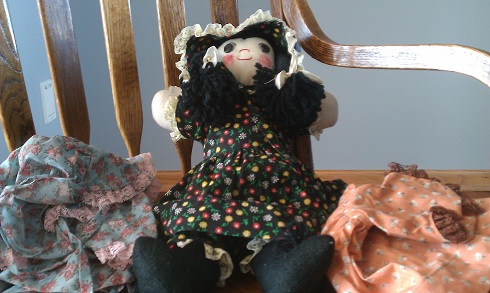
We sold these "Charlotte" dolls. They were made by an old lady who remembered when Mary Ingalls used to sit out on the front step of their house. My friends and I bought dolls and were probably a little weird about them. The dress on the left is for parties.

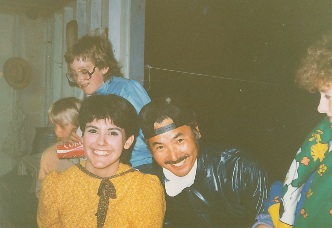
The Pageant: me, as Laura, with a member of the visiting film crew. Maybe the director? I like to imagine that in 1984 I was some kind of equivalent to a rock star in Japan.

It was my job to confuse small children and reduce adults to disappointed tears by telling them that the stories of Laura Ingalls as portrayed on the television show, “Little House on the Prairie,” starring Michael Landon and Melissa Gilbert are, to a large extent, fictional. No one who loves that show wants to hear that Albert was a made-up character, or that little Laura never climbed to the top of a mountain to offer God her life in exchange for the baby’s (there are no mountains within hundreds of miles of De Smet.) Look on the bright side! we urged. Mr. Edwards and Nellie Olson were real and featured in several stories in multiple books! Real life on the prairie was difficult, charming, and just as cool (if not as action-packed and dramatic,) as it was on TV! Really! At the height of the season the crowds were unrelenting. During the day I’d repeat the memorized script so many times that I’d wake myself in the middle of the night, sweeping my arm to the right and saying out loud, “…and here is an actual dresser built by Charles Ingalls, who, as you might recall from the books, was a skilled carpenter.” We wore long dresses in keeping with the period, though no corsets, and as little else as possible because it was hot in those houses, especially when they were crammed with tourists. It was hard work, but I loved all the curious people who wanted to know something that I could tell them. Laura fans tend to be wonderful folk. I loved the old houses and the history and the challenging  questions and how there was no mud or manure involved (see related posts: The Pig Years.) There was even some fame to be had. The year I turned eighteen, the only year I participated in The Pageant, I was given the role of Laura. That same year, some Japanese filmmakers visited De Smet for part of a documentary they were making on Laura’s life (she is HUGE in Japan–I mean, we had tourists from all over the world, but evidently Japan LOVES her.) The LIW Society made a special exception and allowed them to photograph and film parts of the houses, and the crew also recorded at least part of The Pageant. We understood each other not at all, but everyone was very nice and so enthusiastic. I had a mullet that year, as was fashionable, and so my braids were stumpy and French, but no one seemed to mind.

Signing autographs before The Pageant. Note the braids. I find myself wondering what the kid in the blue jacket is thinking about.

Related Post: Working Girl, Prologue

Related Post: Working Girl, The Pig Years
Working Girl, The Pig Years

The single-digit or subzero cold spells are the times I remember best. Trudging out to the back field, through the arcing windbreak of leafless trees, there was no sound except the crunch of snow beneath my heavy boots. Soft tissue inside my nose and throat cringed as the icy air assaulted wherever it could reach.  I opened the front of the little shed where the feed was stored and filled white five-gallon buckets with pulverized grain. Repeated trips carrying the buckets six steps up to the platform, lifting, and emptying gave me the shoulders of an Amazon. By the time all was ready, my face, hands and feet would be freezing, but my core would be sweating under my puffy insulated coveralls Then, I opened the door.

To farrow means to give birth. The farrowing house was a maternity ward of a sort. The tropically steamy atmosphere inside frosted and fogged my glasses, blinding me, as the walloping stench took away my breath. A farrowing house is built over a pit, a cesspool for swine. Adding to the pungent reek of excrement and urine was the very specific pig smell impregnated into the dander, which floats invisibly in the air and settles on every surface including my skin, clothing and every strand of hair. I was resigned to the fact that I would smell like this place when I was done. The sows were confined in two rows of crates, seven on each side facing a center aisle with a food bin and water dispenser by their heads. Heating mats on the slatted floor and hot air forced noisily out of the blower kept everyone toasty, regardless of the outdoor clime. Bars inside the crate kept the mothers from turning around, reducing but not eliminating the chance that they would lie down on their young, who milled around the perimeter of the crate, and smother them. If I found a poor dead piglet, I had to reach in and remove it ASAP. (DON’T READ THIS, YOU OF DELICATE SENSIBILITY!) Sows often chew on their own dead piglets, I don’t KNOW why, (psychosis, hiding the evidence?) but I will tell you that picking up a dead piglet is much less traumatic than picking up half a dead piglet. And on a hot summer day, having a feed bag containing a dozen whole and partial dead piglets break open at the bottom and spill out over your shoes will mark you for life. Life. (DELICATE FOLKS, YOU CAN BEGIN READING AGAIN!)

I moved down the center aisle, pouring feed into the bins, so the sows could in turn nurse their offspring, the reason this was all in place.  I have never heard a pig “oink.” Our pigs either grunted or more frequently barked with a toss of the head, baptizing me with saliva and snot. It could be argued they were joyously greeting me, the bringer of food, but I think not. To reach into the crate, I had to face down their intimidating teeth and beady, glaring eyes. It was a contrast to the sight of a pile of newborn piglets piled in a warm and content heap, sleeping and occasionally flapping a delicate pink ear or tail. After feeding was cleanup when I used a scraper to break up the piles of manure, (which I called shit loudly and repeatedly inside my head,) pushing it between the floorboards into the fragrant pit below. “It’s just dirt,” as my dad said, often, in exasperation or amusement.

When the piglets were big enough, they graduated to the next room in the building, dedicated to feeder pigs. Liberated from the constraining and threatening bulk of their mothers, the young pigs scampered in pens with their friends, eating, sleeping, urinating, defecating and socializing until they were big enough to sell.  With thunderous little hooves stampeding in tight circles and excited squealing in unison, the sound was deafening. Much more filling and emptying of heavy buckets, but the excrement was more manageable. All done, the door shut behind me, I breathed in deeply the silence and the pure arctic air. This was my first paid job. Every day I tended the pigs, I drew a tally mark on the blackboard in the house. Every so often I’d call Dad to account. I wish I remembered how much one hour, give or take, in the pig house was worth. I learned a lot about dirt and unpleasantness and doing the job anyway. I learned about being responsible. I learned about showering so thoroughly that no one would ever guess how I spent my after school time. This is what I do, I assured myself, not who I am. But of course it is both. “It’s good for you! It builds character,” Dad used to say, and no matter how many showers you take, character never completely washes away.

Friday Night

Crushed red pepper dances on my lips and tongue. Pizza has been delivered and eaten (deluxe for us and cheese for the kids.) My husband and I argue over whether I have taken the lion’s share of the 2007 Silverado cabernet.

(So tasty, what if I did ?)

Highlights of another wild Republican debate await analysis and potential mockery.

It must be Friday night. There is always a lot to think about and recover from when the week’s end arrives. Situations immediate, local, national and global prompt consideration and discussion, but not too much. The wine softens the edges, a much-needed deceleration of intensity. The news tells us danger impends from every direction. Fine, whatevs. I can only be so freaked out for so long. Cynicism threatens.

What has changed? Nothing. Politicians have threatened us with Armageddon for being fooled into buying their opposition’s line. Ships have run aground. The younger generation has raised the standard of attention-seeking misbehavior. Nations have raised the specter of war against their neighbors and ideological opponents. This has been going on forever. At what point does our civilization’s impending destruction become blasé? At the point where it becomes a marketable form of entertainment and advertising revenue. So, forever.

Seriously, we have plenty to worry about. But what use is it to worry or complain when there are things we can do to help? We can raise a voice of reason, give a hand, donate time or money or lend an ear. We can give up our self-gratification for a few minutes to put someone else’s needs first. We can take a breath. Let’s start now.

SOPA thoughts

Hey Wordtabulous readers! I have friends who are very correct to have concerns about copyright infringement on their artistic works, and I feel their pain. I pay for my downloads, preferably directly to the artist. However, I believe that generally, more freedom is better than less, and that very good intentions can and frequently are corrupted to benefit wealthy, powerful interests to the detriment of “the little guy.” This has been worrying me for some time, and I thank WordPress for giving us the opportunity to do something about it. Read on for more from WordPress:

Many websites are blacked out today to protest proposed U.S. legislation that threatens internet freedom: the Stop Internet Piracy Act (SOPA) and the Protect IP Act (PIPA). From personal blogs to giants like WordPress and Wikipedia, sites all over the web — including this one — are asking you to help stop this dangerous legislation from being passed. Please watch the video below to learn how this legislation will affect internet freedom, then scroll down to take action.

http://fightforthefuture.org/pipa

For some reason (conspiracy? bad coding?) the real blackout page you are supposed to be seeing isn’t working. I have sort of  patched together my own version to get the gist across. Thank you for hanging in there with me, and Peace!

Working Girl, Guest Post

I spoke to my younger sister, Michele, about the chore girl days, trying to refresh and confirm my memories of our splendid training for the world of work, and she shared this story that I had completely forgotten. Sometimes the two of us did the chores together, sometimes we took turns, heartlessly sacrificing our sibling to the dark so we could enjoy the comfort of a peaceful and well-lit evening indoors. I told her to write the story herself and she did:

Dog and cat chores – the last duty of the day before bed. Sounds simple enough looking back — mosey on out to the clinic and shed behind the house, make sure the two dogs and multitude of cats have food and water, pull all the doors closed and make sure all the animals are locked in. Did I HAVE to wait until after dark to do these duties? No, probably not. I’m not sure that doing them earlier occurred to me often, if ever. Summer was extra treacherous, between unwitting toads waiting on the well-worn path and junebugs springing from the lights we flipped on to say goodnight to the animals. Winter time was easier, and I remember pulling on my dad’s snowboots by the back door if the snow was deep, or sometimes borrowing his slippers (with the mashed-down heels — he never put them on all the way) for chores if there wasn’t snow at all… How far was it from the back door of our house to the lean-to? Waaay too far… Especially after a scary movie…

Apparently, on Jan. 27, 1978 (if the horror movie blog I just found can be trusted), when I would have been all of 8 years old, it was my turn to do chores that night. I couldn’t yank myself away from the tv because we were watching a scary, made-for-tv movie called “Bermuda Depths.” I don’t remember anything about it other than what must have been close to the last scene, the body of a man being dragged into the ocean by a giant sea turtle… But our animals must be fed, movie or no movie. Duty-bound, that image still haunting me, I went out into the cold dark to lock up the animals.

Now, just so there is no confusion — there is no sea anywhere close to where we lived. The largest body of water nearby was the watering tank for the horses, and in a South Dakota January, there was definitely no danger of a giant sea turtle dragging me to my death… These arguments didn’t matter at all to my freaked-out eight-year-old brain. There was definitely something in the dark that was going to come out and get me — maybe the ghost of that drowned person in the movie. So, tip-toeing through the dark, bright light at my back, my own, elongated shadow leading the way across the gigantic back yard to the shed, I was telling myself “it was only a movie” while the rest of my brain was certain I was going to die.

I made it to the corrugated steel shed with a bit of relief — so close to a light switch. I flipped back the metal hook from the eye to unlock the big sliding door, grabbed the smooth, cold handle and heaved it back. As the wall of grey steel slid past and the shed yawned open, I leaned in to flip on the light and a large translucent blue hand floated out of the dark to meet me, reaching for my face.

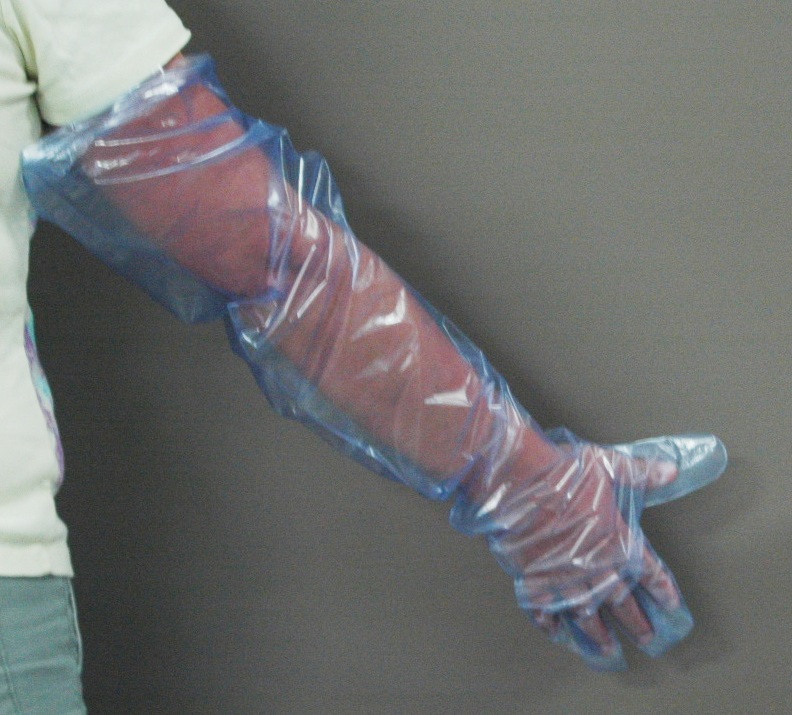
“Gaah!!!!” a strangled gasp escaped my lips as the hand ballooned out of the darkness. I was a goner. The hand slowly wafted down again in the yellow light from the stark incandescent bulb I’d managed to turn on. Drenched in adrenaline-induced sweat, I realized that what I was looking at was an O.B. sleeve — basically an arm-length clear plastic glove that our veterinarian father would use when examining female cattle. This one, (apparently unused) had the open end tied around the top of a CO2 cylinder for welding, leaving the hand-shaped end floating in the dark, reaching out for a short, unsuspecting victim who would free it with the movement of the door.

Giddy with relief and the afterburn of terror, I finished up the chores and returned to the house in record time, just glad to be alive.

Yep. Terrifying in many ways. Image from http://www.vetprovisions.com.

Working Girl, Prologue

I have had the jobs. Some would curl your hair. Some might make you cry. You will be jealous, amazed and appalled.

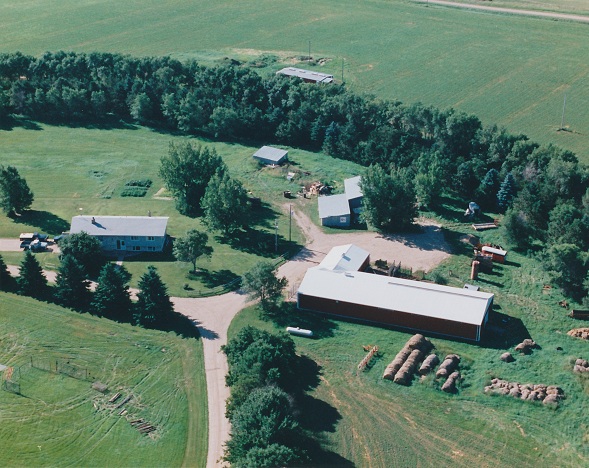
This is a series which requires this prologue because my first  “job” was unpaid, working for my family. This is true of many kids, particularly kids in the farming community, though I was not, technically, a farmer’s daughter. My dad was one of three local veterinarians in our small town. He had what is referred to as a mixed practice, treating both large and small animals. Our house (the building on the left in the photo,) was about a mile outside of town. Dad converted one of our two garages into an office (on the left side of the house, above) where he did small animal examinations and surgeries, and kept the records and pharmacy. The office always smelled of disinfectant and yellow sulfa powder, and occasionally, catbox. Shrill barking or yeowling often accompanied the day if we had tenants in the two small animal cages.

Outside, we had a front pasture, a back pasture, an alfalfa field and several outbuildings.  We kept, at various times, peacocks, steers, lambs, a burro, and pigs. We always had horses, dogs and cats. We had so many cats we gave up naming them. We usually had other people’s animals around for treatment or kenneling. We also had people. We were a family of five including three daughters, of which I am “the middlest.” We usually had a secretary helping out at least part-time during office hours, and sometimes we had a trained vet assistant or new vet intern living with us in our guest room. When he didn’t have someone like that to help during busy times, Dad would hire a “hand,” usually a local high school boy, to work with him on the place and go out on calls. Dad had a fiberglass box that fit into the back of the pickup truck, with doors that opened to reveal drawers, bins for instruments and meds, and refrigerated storage for antibiotics. It smelled of gravel roads, disinfectant and dog hair. We had a two-way radio in those pre-cellphone days that helped us keep Dad rolling day and night. Dad’s appointed rounds kicked the postal service’s ass.

Mom did the books and managed the office. We girls helped, marginally, with housecleaning, and with other chores. It was always us younger girls’ job to take the dogs out to the clinic in the evening, and feed and water them and the cats, and any visiting animals. Except during the longest days of summer, this meant traversing the big, dark empty space between house and outbuilding. The light from the front door didn’t reach all the way to the clinic so we got pretty speedy, once the dogs were penned up, racing back to the house. In case there were, you know, monsters or something stalking us out there in the dark. My little sister had a fear of stepping on a toad, so she not only had to be fast, she had to step lightly. She got pretty close to high speed levitation. We’d arrive back at the front step, huffing and wild-eyed, just before getting ready for bed. Other jobs included horse chores, pig chores, yard and garden (same as anywhere,) and office and clinic help, our topic for today.

As I said, we had a secretary part-time, and Mom covered the office most of the rest of the time. Dad was often around, working on animals or projects in the clinic. But there were gaps; Mom needed to get something in town, Dad was on a call, the secretary was at lunch or getting supplies from an outbuilding, or  it was her day off. From the time my older sister went off to college, when I was ten years old, we younger girls had to cover the office from time to time, dealing with the public, answering the phone calls, relaying client questions to Dad over the tw0-way radio.

This is how that worked. The office phone rang (spoken rule: answer the phone with the words “Val-Vet Clinic” no later than the third ring; implied addendum: kill yourself if you have to to get there in time.) We got the pertinent information, and then, keeping the client on the line, called Dad on the two-way.

Me: “KNGY-976, Base One to Unit One” (Note: For a long time, there was only Base One and Unit One. Then my dad opened a second office twenty miles away and hired a vet who also had a truck so then there was also Base Two and Unit Two. Not confusing at all.)

Dad: “Unit One.”

Me: “Yeah, I’ve got John Smith on the phone? He says he has a cow with a prolapsed uterus? Over.”

Dad: “Ask him how long it’s been that way. Over.” (I do.)

Me: “He says she calved last night, but was still straining when they turned in, so he guesses sometime this morning. Over.” (It’s now 5:00 pm.)

Dad: (Pause while he swears.) “Tell him I’ll be there when I finish up at the Halvorsen’s. Probably be an hour or so. (Another pause for swearing. He won’t be home until well after dinner.) Over.”

Me: “10-4. Over and out.”

YES, I got to speak radio code for REAL! It was cool, even if it made me very nervous. I remember being informed the FCC monitored our little conversations and could prosecute us if we did it wrong. I am sure now that my parents meant we shouldn’t be silly using the radio but I developed a Big Brother complex at an early age. Oh, and “prolapsed uterus?”  I was proficient at saying it long before I knew what it meant.  I always prayed someone would turn up to answer the phone before the dreaded third ring, but phone duty was not the biggie.

The WORST was when we heard a vehicle pull up, and some farmer, usually one we didn’t know, rang the buzzer. I remember looking at my little sister. “You go,” I told her. “No, it’s your turn,” she’d say. “Please?” I begged. She’d either roll her eyes and go or refuse and I’d descend to the office, thinking dark thoughts. I just wanted to watch Gilligan’s Island. Typically, the grizzled farmer would be standing in the reception area, in his shit-spattered working best, looking as askance at me as I was at him. “I need some penicillin,” he’d say. “How much?” I’d ask. “Better give me two bottles. Oh, and some boluses. Give me three of those.” If the client needed something more exotic than ear tags, cat or dog worm pills, syringes and needles (you heard me,) or the above mentioned goodies, I’d have to give Dad a call on the two-way to clarify. If Dad was away from the truck, say with his arm inside a cow trying to restore a prolapsed uterus, Farmer Smith and I would be on our own. “It isn’t the penicillin I want, but I don’t remember the right name.” “Tetracycline?” I’d guess. “No, that isn’t it. I think Doc keeps it in the second refrigerator.” I’d rummage and pull out a couple of bottles for him to check out. “That’s the one!”  Then I’d look up the prices and write up a ticket, praying I remembered how to do it correctly, how to figure tax on the monstrous adding machine, which copy to give the client, and generally trying not to look like an imbecile. At least once I even filled in the check blank for a client who “forgot his glasses” so he could sign it. Please consider this, an eleven or twelve year old girl alone in an office full of drugs, some of which could be recreational, with a cash box, dealing with total strangers who drove in off the highway. It was a more innocent place and time. I did it all the time, and the biggest thing I worried about was screwing up. If a client didn’t get what he needed from our office, he’d go to another vet. This was unthinkable. On the other hand, there were lots of ten- and eleven-year-olds driving pickups and tractors around on their family’s farm fields, literally farming. I didn’t learn to drive until I was fourteen at the earliest, so in some ways, I was a late bloomer.

Sometimes Dad would call one of us down to give him a hand during small animal surgeries, like spays.  We’d help hold the animal until it was anesthetized, then stand by while he laid it out on its back and tied its paws with gauze to rings on the sides of the stainless steel operating table, and shaved the incision area. Dad scrubbed up and we would help him into his surgical cap, mask, gown, and gloves. Dad looked just like the surgeons on TV as he made the incision, splitting open the iodine-swabbed abdomen. The inside of a living creature has a distinctive aroma that is hard to describe. It isn’t quite like meat, and if the gut is intact, there isn’t a fecal odor, either. It is a solemn, unsettling smell. There is an inescapable feeling of voyeurism, viewing the tender, pulsing organs in various shades of pink and gray. Our job was to let Dad (who was intently focused on the job at hand,) know if the animal stopped breathing. Dad worked, and I watched closely praying the whole time, afraid I’d miss the moment the short, spread out gasps stopped completely. Afraid I wouldn’t alert my dad to trouble in time. Life and death. My first job.

Two Things

I. I am having this kind of day, for a few days now.

This is why you aren’t hearing a lot from me…I’ll be feeling a little more extroverted and generous with my words soon, I am sure.

II. This is a cool video from youtube that my younger son wanted me to see (a. my younger son and I shared a moment–yay! and b. wow, is this video ever cool!) It appears today’s post is in outline form…

Anyway, the video is the group Walk Off the Earth, covering the Gotye song “Somebody That I Used to Know,” and I think even without the extra coolness of all five of them playing one guitar simultaneously, I like their rendition better. Walk Off the Earth, Ladies and Gentlemen! (Click Play arrow below.)

Reading II

It is textbook season again at State Services for the Blind. Today, I got to finish the college history text, Forced Founders: Indians, Debtors, Slaves & the Making of the American Revolution in Virginia, by Woody Holton. I got the last chapter and a half, and the Epilogue. Reading history silently tends to make me sleepy, but reading a good text out loud is, weirdly, one of my favorite things. I learn so much! Also I love reading about things from the Revolutionary War that have value today: for instance, be wary of fighting a war on unfamiliar terrain against a foe defending their homeland, and watch out for those grassroots movements during a recession. This was a very good book. Holton gives us a  bit of a cynical take on our founding fathers and how things shook down back in the pre-Revolutionary day, which was just what I was in the mood for. Except for the footnotes, which were a pain in the breeches, I enjoyed reading it for three and a half hours today. I had to make a lot of corrections to my work, because I found in this text, as in many academic works, the author will zig when I was expecting a zag, tripping me up. I’ll be reading along and then a sentence or two later there I will be in my little recording booth, saying out loud, “Oh. Ohhhh! That’s what you meant.” Erase. Re-record. There are a lot of ways to err, as a reader. You can mispronounce a word, stumble or stutter within a word, change the meaning with intonation, leave too long a pause as you try to figure out if the footnote is explanatory or a citation, determining whether it needs to be read…and the list goes on. Even when I am (totally not sarcastically) having a ball reading, I’ll hit a sentence now and then that will get me swearing and threatening physical harm to the author because although lovely, it was not written with audiotext in mind. For instance, consider the following footnote from page 203:

“Lee, in fact, lost two elections in April 1776. After his defeat in Richmond County, his supporters ran him in neighboring Lancaster, where he lost again. The April 1776 voting was something of an electoral massacre for the Carter family. In addition to Rober Wormely Carter and his cousin Carter Braxton, both of whom actively opposed Independence, two other Carters–Charles of Corotoman and Charles of Ludlow were also defeated. The Carters were among the wealthiest families in Virginia, and their unprecedented repudiation at the polls seemed to reflect the ascendancy of antielitism.” (emphasis mine)

That particular finishing sentence caught me on tape in the middle saying, “You have GOT to be kidding.” Erase. Re-record. There were several easier sentences that gave me even MORE trouble, because once I screw something up, I find chances are at least 50% of the time I will screw it up multiple times in the same or different ways. Holton made it all up to me with this next little passage from page 219:

“Between 1782 and 1806, Virginia allowed slaveowners to emancipate their slaves without legislative approval, and some did so. Between 1790 and 1810, the state’s free black population more than doubled, largely as a result of emancipation. George Washington provided in his will that his slaves be freed upon the death of his widow (after he died, Martha Washington, prudently deciding not to make the slaves’ freedom contingent upon her death, freed them immediately).”

So here, I am picturing the reading of the will, and a house slave in the corner thinking, “Upon her death, huh?” and Martha thinking, “That’s terrific, George. Thank you so much…” and out loud saying, “No worries, folks! Freedom for everyone! No waiting!” I had to re-record that one because I got the giggles. Makes you wonder how often Martha had to help George out with practical thinking during the presidency. We’ll never know.

So while it isn’t parasailing, or a night at the comedy club, this volunteer gig has its moments. Besides, where else would I get to use words like “sobriquet” AND hang out with the nicest state employees in Minnesota?

Related Post: Reading, or How This All Started.

Picking a Fight

I don’t think a lot of people who know me in the real world would describe me as timorous, but I am. Sure, I will ask just about anybody a question even if it makes me look dumb and I will brace myself and dive into uncomfortable new social situations as needed , but put me in a conflict situation and all kinds of alarm bells and whistles go off. If I am in the conflict I rush straight to the de-escalation and defusing stage; if I am only observing, I try to take it all in (how are you doing that? how do you defend yourself so handily?) Part of my problem is that the stress of the interaction shuts down my brain so I simply cannot think of any of the arguments that would back up my position. I know you are wrong, I might think, but I can’t quite work out why with you standing there grinning (or snarling) at me. Although in my head it sounds more like Aaaaaaghh! Think dammit! Aaaaaghh!

Obviously this is not how a mature adult should function, or at least not how I want to function. I thought what I needed was practice, so one evening, while having a glass of wine with friends at their home,  the conversation turned (as it does,) to Guantanamo Bay and the treatment of suspected terrorists, and I thought, here we go. Why this topic, Lynnette? you might ask. Such a politically and emotionally charged issue seems like rather big potatoes, perhaps you should have started with something smaller, like whether consumers should be forced to buy fluorescent bulbs or whether wool or microfiber makes a better base layer when working out in the winter? Well, maybe. Here is what I was thinking: Guantanamo at this point was covered ground. The arguments had already been made many times in the media, and I was familiar with both sides. I also felt that both sides had valid concerns and that, to me, made it safer. A reasonable person would need to cede at least one “point” for opposing valid concern so at minimum, I’d have that, right? I am so silly sometimes. Anywho, my friend, who is conservative AND former military took the position of ” terrorists are trying to destroy us and we have to do whatever necessary to protect our country and our people,” leaving me with “if we are the bright light of civilization we had better act like it and torture puts our citizens who are outside our borders at greater risk.” Now don’t get all excited about this, I have political and philosophical leanings but for the most part I am all “jeez-o-pete there are a lot of good points here and I really don’t know what the right thing is.” This is another reason I suck at arguing, but I was TRYING. I guess I thought it would build character or something.

So instead of just letting the opinions roll over me as usual, I picked up the other end of the conversational rope and gave it a congenial tug. At this point, I am sure both Mr. Wordtabulous and my friend’s wife (who is also my friend) thought, “Oh, shit.” But I was all, this is fine, two adults respectfully sharing opposing views, we’re all friends here, cool. But one of us wasn’t cool. One of us was increasingly loud and ranty. I was increasingly uncomfortable, but after all, the purpose of this had been to push the envelope. I tried to keep things calm and conversational but that was a unilateral strategy that broke down when my friend shouted into my face, “I hope you’ll be happy the next time one of our soldiers gets killed by an IED!!” I looked at him in shock and then stormed out of their house, slamming the door behind me. He sent me an email the next day or so, saying that the episode was unfortunate and he didn’t feel arguments should get in the way of friendships. And we all picked up from where we had been BEFORE I began my little experiment.

My processing of this event has been in stages. My first stage was, “My friend is an ass.” Which isn’t true. He is a hard-working, loving husband and father who volunteers his time in the community and has genuine concern for others. So I got through that phase pretty fast. Next I thought, “I still suck at arguing, and now I’m traumatized, too. I guess I’ll never do that again.” I held onto this phase a really, really long time. But recently I was at State Services for the Blind, doing my thang of reading books into digital media and was assigned the job of finishing At the Oasis by Bill McDonald. It is a collection of essays by the Minnesota writer on a wide variety of topics. One of the essays was on his three “round tables” in which he and others engage in debate over events and ideas of the past, present and future. Tears are not welcome, he warns, but then says that all viewpoints are. The  more I read, the more I believed that lively doesn’t necessarily mean combative. Maybe, I thought, I’m not the only one who could use some pointers on argumentation (looking at you, argumentative friend.) Maybe I just need to find the right folks to disagree with, and establish the goal of fleshing out and truly understanding the subject as opposed to winning or losing a match. I am not itching for a fight, per se, but am starting to think that when the next one comes my way, maybe this time I won’t avoid eye contact. What could possibly go wrong?

I only read the last few of McDonald’s essays, so I can’t give a full review, but the one he wrote on whether the citizens of the US could ever vote away their democracy as did the citizens of pre WWII Germany was both thought-provoking and moving. Check out his work on Amazon or via the link at the title above if you are interested!