Author Archives: lynnettedobberpuhl

Unknown's avatar

About lynnettedobberpuhl

I write, read, work in children and youth ministry, and try hard to be better about managing my time.

Warriors on Wheels Part 1: Tour de Cure’s Kevin Wells

Last June I blogged about Twin Cities Tour de Cure, a cycling fundraiser for the American Diabetes Association that I participated in for the first time in 2011. I was blown away by the route, the organization and the amazing people I met. Also by the party at the end of the ride, which was the best ever finish line I’ve crossed (great food, live music, a beer garden and NO speeches!) Janeece, one of my new best friends at the TC Tour de Cure headquarters, asked if I would write a few words about some of the people involved in this year’s ride and see if we can’t get a few more of you as excited as we are about the upcoming event (Saturday, June 2, 2012! Save the date!)

A lot of people I have talked to who have gotten either the Type 1 or 2 diagnosis have talked about the changes they have had to make as a result of their diabetes. Some of the changes are to improve health, like healthy eating and weight management, and other changes, like blood sugar maintenance, are to prevent health problems. When I spoke with Officer Kevin Wells at the 5th Precinct in Minneapolis, I was struck by the fact that when he was diagnosed in 1993, he was already a long-time nutrition and fitness enthusiast. His approach to diabetes seems to be to not let it change the way he likes to live.
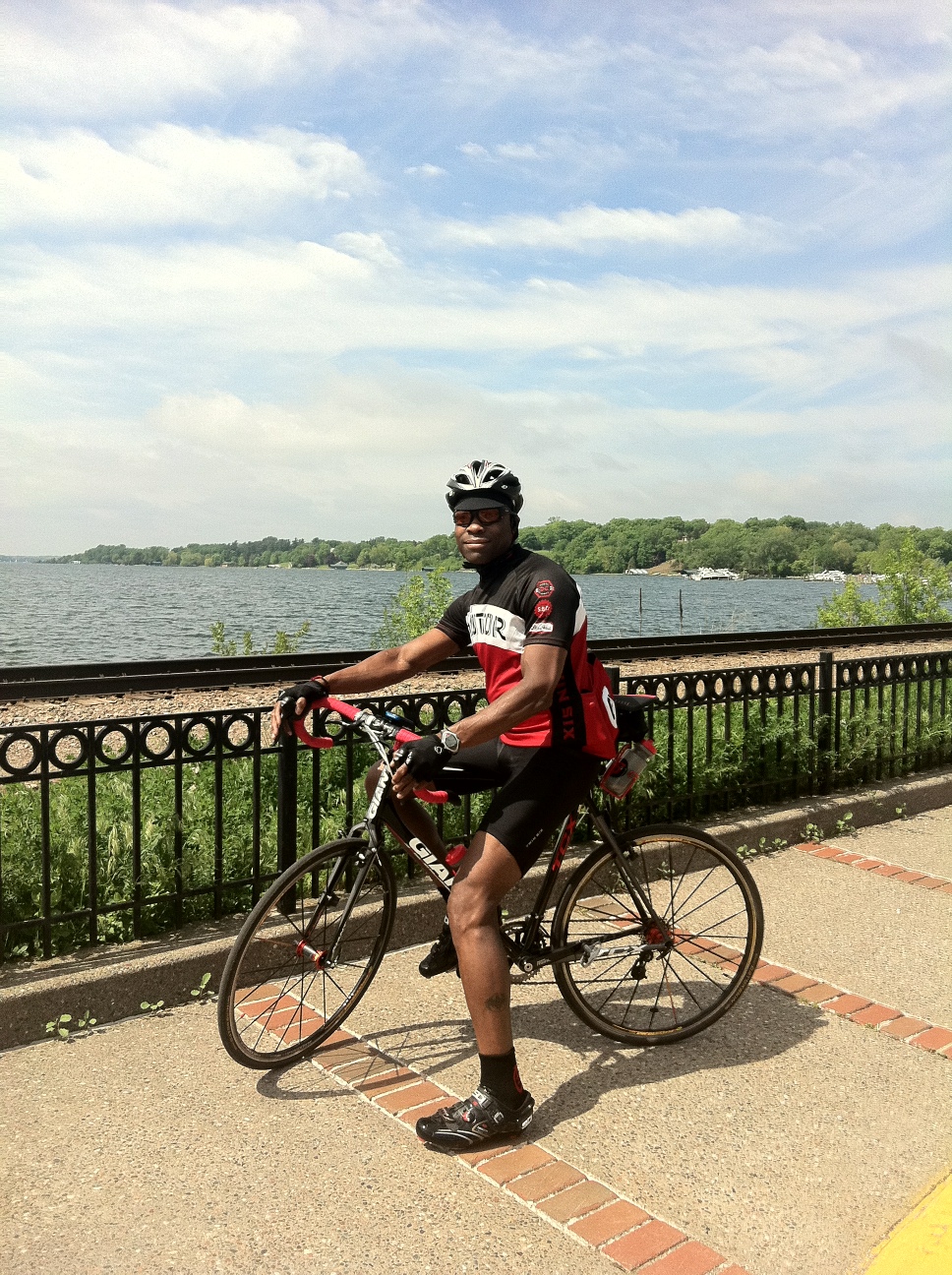
Kevin’s passion for cycling began in 2005, when he took an indoor spin class to add something new to his workout regime. “Everyone there talked about riding outside,” he says, so he tried it. “I fell in love. That was the first year I did the Tour de Cure.” He commutes to work on bike whenever he can and pushes himself with distance and/or intensity on training rides outside as often as possible, or inside on a trainer when the weather is bad. In addition to the fun and challenging workout he found in cycling, Kevin discovered another obsession: the gear. He now owns several bikes and a plethora of garb, cycling computers, GPS systems, and other things that take his ride to the next level.

I asked Kevin if his intensity with cycling complicates his blood sugar management. “Long steady rides will continuously burn carbs,” he explains, “so you just have to be sure not to let your blood sugar fall too low. The way I ride pushes my anaerobic threshold, which is where the blood sugar actually spikes. When I don’t feel good on a ride I have to test [my blood sugar] because I can’t always tell if I feel off because I am low or high. I don’t let it stop me, though.”

Kevin enjoys other cycling events, such as the Tour de Tonka, and local duathlons, but Tour de Cure has a special place in his heart. “The Tour is a great, fun event. I’ve met a lot of nice people, and the food’s good. Last year, I rode the 62 mile route, and commuted to the event and back home on my bike, so I got in 100 miles. I calculated that I burned 6,800 calories that ride. I felt great.”

The folks at TC Tour de Cure would like to thank Kevin Wells for supporting the Tour with his participation and story. Please join Kevin, myself and the other riders at the event either by riding or joining the ranks of volunteers, or consider donating to support the ADA drive for research, education and advocacy for people with diabetes. You can get started by clicking on this link:  TC Tour de Cure.

Related Post: Tour de Cure: The Finish Line

Getting Better? Or Just Older?

Yesterday, aging in my world was having to straighten up carefully after bending over, because of the ever-so-slightly degenerating disc in my lower spine. Today it was lifting my eyelid (which has somehow become a bit ruched) so I could get my eyeliner where it belonged. Just the left one. This is the new normal? I asked my reflection in the mirror.

I don’t suppose anyone jumps up and down when these things start and says “Yes! Visible aging! Just what I always wanted!” On the other hand, what I am talking about is small change compared to problems some of my contemporaries are dealing with, and what I glimpse on the road ahead. When the boys were growing up, I knew people who said, “Oh, I couldn’t wait for the (whatever) stage to be over,” because they were really looking forward to engaging their kids at a higher level, or to when their kids became more independent. I have made a point of celebrating every one of their phases, even when I felt it was literally draining the life from me (middle school, my eternal nemesis!) Living and loving every stage my kids went through is a lesson I learned from being in kind of a rush to grow up. I was uncomfortable with myself as a teen (who isn’t?) and wanted to skip ahead to the independence and presumed confidence that came with adulthood. Looking at kids now, I feel I missed some opportunities trying to race through the awkwardness.

Every decade has brought its gifts. Confidence and comfort in my own (somewhat sagging) skin continues to build. I appreciate people and opportunities more, and value time like I never did in my youth. Living in gratitude does change everything. Well, except the aches and the reduced elasticity. It could always be worse. One of my favorite radio commercials (don’t remember the product, of course–memory lapses) announced, “Sometimes wisdom comes with age. Sometimes, age comes alone.” I hope the wisdom I am gaining offsets the memory lapses, etc. and that, as bits and pieces of my physical self start to corrode and crumble a bit, that some of the sharp edges on my personality also soften. I project it won’t be that many years before I fully reach the “shabby chic” stage. I just hope it won’t have completely gone out of fashion when I do.

What are the ups and downs of the age you are at?

The Lighting of a Fire

Here is a very special Lucy’s Football. Amy usually writes very witty, irreverant, and verbally spazzy posts that make me laugh out loud. This post, still entertaining but written in a more serious vein, brings up the issue of the mastering of English by our high school students (or the lack therof.) Click on the link “Reblogged from Lucy’s Football” at the top to read the whole thing. I hope you enjoy it, and please check out some of her other posts!

When Time Stops, Moonlit Moment

Words streaming through my brain, linking, twisting, and rejoining—urgently and repeatedly, drove me from my bed at 4:38 this morning. Intent upon capturing some and exorcising others, I slunk down the stairs to find my west facing living room aglow in moonlight. I stopped, as did the words in my head. As much as I admire sunrises and sunsets in all their varying colorful glamour, the moon exerts a pull on my heart as of tides. Her cool monochromatic sublimity loosens my grip on the fevered daytime strivings that have followed me into the night. Stop now. See. Breathe.

Working Girl, Howard’s Restaurant and The Peanut Shack

I spent my first year of college finding independence and re-inventing myself, forty miles from home in Brookings, SD. Baby steps. Brookings was a town of about 15,000 people, which grew by 7,000 when classes were in session at SDSU. I could have returned to my awesome tour guide job in De Smet, but that would have entailed moving back to my parent’s house, which was unthinkable. Two friends and I rented a small two-bedroom house near campus for the summer and got jobs. I got my first waitressing job at Howard’s Restaurant, an independent family-style place on 6th Street. The owner, Howard, was the main cook. Howard was a chubby man with a pointed face who taught me that orange juice is like gold and nothing is free. He had a young guy who worked the grill and a crew of waitresses, four or five of us, the others all with experience and drive. I felt out of my depth when I started there, but was sure I would catch on.

Howard’s had amazing hand-dipped shakes and malts; egg-nog and butterscotch were my favorite, but his specialty was  fried chicken, the preparation of which fell to the wait staff. While the others were jockeying for the good shifts out in front with tip-leaving customers, I, unaccountably intimidated by both the customers and the other waitresses, slumped into the back room and pried half-frozen chicken pieces apart so they could be batter dipped. I found out that my hands are painfully sensitive to cold and that I hate the wimpy side of my personality that trembled rather than demanding my share of shifts out front. No one was doing great, because even though the food was decent and reasonably priced, the traffic just wasn’t there. They made me choose a different name because mine, Lynnette, was too similar to one of the other waitresses, Annette, which was confusing. I refused to go with Lynn, so I took Val, from my last name, Vallery. Val became my alter-ego, and not the fiery kick-ass alter-ego I would have enjoyed, but the one who was trying to warm up her hands and wondering how she was going to pay for both groceries and rent.

Halfway through the summer I saw an ad seeking a manager for the Peanut Shack at the mall. Peanut Shack was a counter-front shop that sold fresh-roasted nuts, popcorn, and a variety of candy that we either freshly prepared or purchased. The manager’s job was to work shifts, hire and train staff, schedule other people to work shifts, track inventory, keep my mouth shut when the owners came in and grabbed a handful of cash out of the register to go shopping, and balance the cash drawer as well as possible under those circumstances. I rarely saw the owners except when they stopped by for money. I enjoyed the autonomy. The mall was small and in summer doldrums. Most of my customers were people who worked there. I stocked the Jelly Belly jellybean jars, I roasted cashews and other nuts, and made nut clusters with white, milk and dark chocolate. I dipped potato chips in chocolate and begged people to try them, because they were amazing. I made a homemade version of Almond Joys that taught me to love coconut. I could eat as much of the popcorn, nuts and handmade candy as I wanted, and got a discount on the candy purchased from headquarters. I loved the products, but quickly got sick of eating them as my main sustenance, and daydreamed of pot roasts and lasagna. When my parents gave me a beautiful Black Hills gold ring for my birthday, I was disappointed. My heartfelt desire was three big bags of groceries.  They had no idea. Of course, I also spent some of my hard earned wages on cheap 3.2 beer at the Lucky Lady,  the only bar that served 18-20 year olds in town, but I couldn’t have bought much of a pot roast with what I spent on happy hour brews.

I counted boxes of truffles and caramels and jellybeans, and cartons of raw nuts and chocolate for melting. I worked as much as I wanted, and more, when my meager staff didn’t show up for their assigned shifts. One day a woman came up to the counter and asked if I had any jobs. I looked at her in disbelief. Her hair was greasy and snarled. She stared at me blankly, breathing heavily through her mouth. Her blouse was misbuttoned, gaping open between her unrestrained breasts, and didn’t match her stained polyester pants. “Nope, no jobs here,” I told her, and she shoved a paper at me to sign for the unemployment office, attesting to the fact that she had indeed applied for a job at the establishment. The light went on–she had dressed, not for success, but for failure. Mission accomplished, signed and good-bye.

This was also the summer I rode everywhere on my big sister’s ten-speed bike, which she had given to me for my birthday a few years before. It was my sole mode of transportation until the accident. I was approaching an intersection where I had the right-of-way and the cross traffic had to stop. Seeing a car approaching the stop sign, I slowed slightly to make sure they were really stopping, then pedaled forward. The driver came to a complete halt, and then, when I was just past the center of her grill, she went, knocking me across the hood of her car onto the street and crushing my bike beneath her tires. “Don’t move! Don’t move!” she and a few passersby insisted, and a police officer showed up, but spent most of his time talking to the driver, who told me her husband owned the Taco John’s. Eventually the hot, gritty asphalt became too uncomfortable and I crawled to the curb, surveying my road rash and crippled bike glumly. The driver took me to Kmart a few days later and bought me a brand new Huffy ten-speed that cost probably a fourth of what my sister had paid for her bike, but I didn’t know any better. I named it Grace, and instead of becoming nervous about riding, I started edging toward a daredevil mentality, blazing through town in the dark of night, alone. That was where I found my kick-ass alter-ego.

At the end of the summer I went back to classes full-time, and declined an invitation to stay on with The Peanut Shack. Weeks later the owners went into bankruptcy and the store was closed for months before anyone else took it over. Howard’s Restaurant eventually folded and remained vacant a long time as well. Summer is tough going for business owners in a college town, and it isn’t a picnic for the people who work for them either. I never took another job in the food service industry, though I deeply respect the people who are great at it. For me, there were other worlds of work to explore.

Related Post: Tour Guide, Laura Ingalls Wilder

Related Post: Working Girl, The Pig Years

Working Girl, Laura Ingalls Wilder

When I was sixteen, I scored one of the best jobs of my life. I became a tour guide for the Laura Ingalls Wilder Society. My hometown of De Smet, SD is famous for its connection to the writer, author of the Little House series of books that chronicle pioneer life in Minnesota and South Dakota in the 1800’s. For several years, Laura lived in De Smet with Ma, Pa, and her sisters Mary, Carrie and Grace. She became a schoolteacher and met and married Almanzo Wilder there. Her stories of life in De Smet carry readers through several of her later books: By the Shores of Silver Lake, Little Town on the Prairie, The Long Winter, These Happy Golden Years, and The First Four Years. Wilder’s first books, Little House in the Big Woods, Little House on the Prairie, and On the Banks of Plum Creek featured other locations. In De Smet, we prided ourselves on being the setting of most of Laura’s stories, and having: two homes the Ingalls actually lived in (one of which Pa built,) the graves of Pa, Ma, Mary, Carrie and Grace, and an open air portrayal of some of her stories. “The Pageant,” as it was known by us locals, was performed by volunteer townspeople out on the prairie near the homestead location. Hundreds of people flocked to De Smet each night on the last weekend in June and the first two weekends in July to see amateurs in costume act out parts of the books, or in later years (due to copyright restrictions) original works that were written to reflect the life and times of the Ingalls family. Every summer thousands of people toured the Surveyor’s House (the original, from the Silver Lake book) and the Ingalls Home (built by Pa when the time came to move into town some time after Laura married Almanzo.)

To be a tour guide you had to be reasonably presentable, comfortable with  public speaking, and knowledgeable. We had to know the entire series of books backwards and forwards (no problem as I was a true fan,) but we also had to know the behind-the-scenes facts: the dates of births and deaths, the later lives of the siblings, and the untold year that occurred between Plum Creek (set in Walnut Grove, MN) and Silver Lake; when the family lived in Ames, IA where a baby brother was born and died, and Mary got scarlet fever and went blind. We had two tours to learn, one for each house. We learned ticket and gift shop sales and crowd management. On busy days, guides would give back-to-back tours to roomfuls of people, while the next group waited impatiently in their cars or out on the front lawn. We had to keep people from climbing the forbidden stairs in both houses. I’ll grant you, they were enticing, but they were also moderately dangerous and only led up to stifling unrestored rooms where we kept brochures and merchandise. Usually accompanying bus tours was a job that fell to the matriarchs of the guides but sometimes we younger girls were permitted to do this, guiding the driver from house to house to cemetery to homestead site, with views of the big slough, and Lakes Henry and Thompson where Laura and Almanzo took buggy rides.

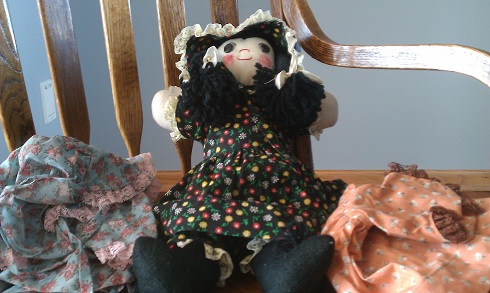
We sold these "Charlotte" dolls. They were made by an old lady who remembered when Mary Ingalls used to sit out on the front step of their house. My friends and I bought dolls and were probably a little weird about them. The dress on the left is for parties.

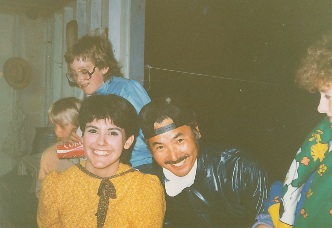
The Pageant: me, as Laura, with a member of the visiting film crew. Maybe the director? I like to imagine that in 1984 I was some kind of equivalent to a rock star in Japan.

It was my job to confuse small children and reduce adults to disappointed tears by telling them that the stories of Laura Ingalls as portrayed on the television show, “Little House on the Prairie,” starring Michael Landon and Melissa Gilbert are, to a large extent, fictional. No one who loves that show wants to hear that Albert was a made-up character, or that little Laura never climbed to the top of a mountain to offer God her life in exchange for the baby’s (there are no mountains within hundreds of miles of De Smet.) Look on the bright side! we urged. Mr. Edwards and Nellie Olson were real and featured in several stories in multiple books! Real life on the prairie was difficult, charming, and just as cool (if not as action-packed and dramatic,) as it was on TV! Really! At the height of the season the crowds were unrelenting. During the day I’d repeat the memorized script so many times that I’d wake myself in the middle of the night, sweeping my arm to the right and saying out loud, “…and here is an actual dresser built by Charles Ingalls, who, as you might recall from the books, was a skilled carpenter.” We wore long dresses in keeping with the period, though no corsets, and as little else as possible because it was hot in those houses, especially when they were crammed with tourists. It was hard work, but I loved all the curious people who wanted to know something that I could tell them. Laura fans tend to be wonderful folk. I loved the old houses and the history and the challenging  questions and how there was no mud or manure involved (see related posts: The Pig Years.) There was even some fame to be had. The year I turned eighteen, the only year I participated in The Pageant, I was given the role of Laura. That same year, some Japanese filmmakers visited De Smet for part of a documentary they were making on Laura’s life (she is HUGE in Japan–I mean, we had tourists from all over the world, but evidently Japan LOVES her.) The LIW Society made a special exception and allowed them to photograph and film parts of the houses, and the crew also recorded at least part of The Pageant. We understood each other not at all, but everyone was very nice and so enthusiastic. I had a mullet that year, as was fashionable, and so my braids were stumpy and French, but no one seemed to mind.

Signing autographs before The Pageant. Note the braids. I find myself wondering what the kid in the blue jacket is thinking about.

Related Post: Working Girl, Prologue

Related Post: Working Girl, The Pig Years

When Time Stops, The Night Sky

One of my bests from childhood was sky-watching. We lived on the flat, open prairie, with few houses or buildings to significantly block the horizon in any direction. On our deck in the company of family or friends, I watched thunderstorms build from miles away and approach with lightning  and thunder rocking the sky and earth, only driving us in when wind and rain reached us under the rooftop overhang. The Northern Lights danced the skies in silence more rarely, silencing us in its beauty. On clear nights in all seasons I’d lie down in the front yard, far enough from everything that all I could see was the sky. Without trees or buildings in your peripheral vision to anchor you, you perceive that you are truly on a sphere in space. That up is no different from down and instead of securely looking up at the sky, you are suspended above the deepest abyss of indigo, midnight and black, set with blazing and muted planets, stars and galaxies, with our own galaxy, indeed, a faded milky streak across the panorama, so impossibly distant it is hard to believe it is home.

The infinite is all around us, all the time. We and everything around us are made up of unimaginably small particles that are buzzing around furiously, as we are suspended in an incomprehensibly large universe full of uncounted objects that are also in constant motion. Quantum and cosmic meet inside our minds where we ponder these great unfolding mysteries. This comforts me on days when little things insist they are a big deal.

Working Girl, The Pig Years

The single-digit or subzero cold spells are the times I remember best. Trudging out to the back field, through the arcing windbreak of leafless trees, there was no sound except the crunch of snow beneath my heavy boots. Soft tissue inside my nose and throat cringed as the icy air assaulted wherever it could reach.  I opened the front of the little shed where the feed was stored and filled white five-gallon buckets with pulverized grain. Repeated trips carrying the buckets six steps up to the platform, lifting, and emptying gave me the shoulders of an Amazon. By the time all was ready, my face, hands and feet would be freezing, but my core would be sweating under my puffy insulated coveralls Then, I opened the door.

To farrow means to give birth. The farrowing house was a maternity ward of a sort. The tropically steamy atmosphere inside frosted and fogged my glasses, blinding me, as the walloping stench took away my breath. A farrowing house is built over a pit, a cesspool for swine. Adding to the pungent reek of excrement and urine was the very specific pig smell impregnated into the dander, which floats invisibly in the air and settles on every surface including my skin, clothing and every strand of hair. I was resigned to the fact that I would smell like this place when I was done. The sows were confined in two rows of crates, seven on each side facing a center aisle with a food bin and water dispenser by their heads. Heating mats on the slatted floor and hot air forced noisily out of the blower kept everyone toasty, regardless of the outdoor clime. Bars inside the crate kept the mothers from turning around, reducing but not eliminating the chance that they would lie down on their young, who milled around the perimeter of the crate, and smother them. If I found a poor dead piglet, I had to reach in and remove it ASAP. (DON’T READ THIS, YOU OF DELICATE SENSIBILITY!) Sows often chew on their own dead piglets, I don’t KNOW why, (psychosis, hiding the evidence?) but I will tell you that picking up a dead piglet is much less traumatic than picking up half a dead piglet. And on a hot summer day, having a feed bag containing a dozen whole and partial dead piglets break open at the bottom and spill out over your shoes will mark you for life. Life. (DELICATE FOLKS, YOU CAN BEGIN READING AGAIN!)

I moved down the center aisle, pouring feed into the bins, so the sows could in turn nurse their offspring, the reason this was all in place.  I have never heard a pig “oink.” Our pigs either grunted or more frequently barked with a toss of the head, baptizing me with saliva and snot. It could be argued they were joyously greeting me, the bringer of food, but I think not. To reach into the crate, I had to face down their intimidating teeth and beady, glaring eyes. It was a contrast to the sight of a pile of newborn piglets piled in a warm and content heap, sleeping and occasionally flapping a delicate pink ear or tail. After feeding was cleanup when I used a scraper to break up the piles of manure, (which I called shit loudly and repeatedly inside my head,) pushing it between the floorboards into the fragrant pit below. “It’s just dirt,” as my dad said, often, in exasperation or amusement.

When the piglets were big enough, they graduated to the next room in the building, dedicated to feeder pigs. Liberated from the constraining and threatening bulk of their mothers, the young pigs scampered in pens with their friends, eating, sleeping, urinating, defecating and socializing until they were big enough to sell.  With thunderous little hooves stampeding in tight circles and excited squealing in unison, the sound was deafening. Much more filling and emptying of heavy buckets, but the excrement was more manageable. All done, the door shut behind me, I breathed in deeply the silence and the pure arctic air. This was my first paid job. Every day I tended the pigs, I drew a tally mark on the blackboard in the house. Every so often I’d call Dad to account. I wish I remembered how much one hour, give or take, in the pig house was worth. I learned a lot about dirt and unpleasantness and doing the job anyway. I learned about being responsible. I learned about showering so thoroughly that no one would ever guess how I spent my after school time. This is what I do, I assured myself, not who I am. But of course it is both. “It’s good for you! It builds character,” Dad used to say, and no matter how many showers you take, character never completely washes away.

Friday Night

Crushed red pepper dances on my lips and tongue. Pizza has been delivered and eaten (deluxe for us and cheese for the kids.) My husband and I argue over whether I have taken the lion’s share of the 2007 Silverado cabernet.

(So tasty, what if I did ?)

Highlights of another wild Republican debate await analysis and potential mockery.

It must be Friday night. There is always a lot to think about and recover from when the week’s end arrives. Situations immediate, local, national and global prompt consideration and discussion, but not too much. The wine softens the edges, a much-needed deceleration of intensity. The news tells us danger impends from every direction. Fine, whatevs. I can only be so freaked out for so long. Cynicism threatens.

What has changed? Nothing. Politicians have threatened us with Armageddon for being fooled into buying their opposition’s line. Ships have run aground. The younger generation has raised the standard of attention-seeking misbehavior. Nations have raised the specter of war against their neighbors and ideological opponents. This has been going on forever. At what point does our civilization’s impending destruction become blasé? At the point where it becomes a marketable form of entertainment and advertising revenue. So, forever.

Seriously, we have plenty to worry about. But what use is it to worry or complain when there are things we can do to help? We can raise a voice of reason, give a hand, donate time or money or lend an ear. We can give up our self-gratification for a few minutes to put someone else’s needs first. We can take a breath. Let’s start now.

An ADD Moment…

And before anyone gets excited, I am not making light of ADD or ADHD. I was diagnosed and treated for ADD for years when I was a kid. Evidently, in first grade, I did a lot of getting up in class and wandering around and often had no idea what was going on. More so than the rest of the kids. Back then, (so, so long ago,) the diagnostic criteria for ADD was this: give the kid Ritalin and see if it helps. If it does, the kid has ADD. So I started taking Ritalin in second grade. The funny thing was that our school had a very aggressive anti-drug campaign and I remember being scared to DEATH that I was going to become a child drug addict because Ritalin is an amphetamine, also known as SPEED. I was afraid that someday, when they took the drugs away, I would start robbing gas stations or hold the pharmacist at gunpoint to feed my addiction. My mom assured me that wouldn’t happen and bought me a little pill-carrier in the form of a jeweled golden treasure chest pendant, in which I stored one and a half tabs to be taken (rather self-consciously) at lunch. I guess it helped, because I stopped wandering around, but I remember still sitting in the classroom wondering why everyone else seemed to know what we were supposed to be doing but I didn’t. In fifth grade we discovered I was so near-sighted I could barely read the E on the eyechart, and eyeglasses helped a lot. (Oh, so that’s the blackboard you people keep talking about.) Back then, once you hit puberty, you were pronounced cured and they took the drugs away. There were no withdrawal-fueled rampages; I barely noticed. Nowadays I have caffeine and a great big kit of marginal coping skills that help get me through the day. But sometimes I still get so DISTRACTED by THINGS. Which is why you are reading this instead of the next Working Girl post, which is in development.

Distracting Thing 1

My Capresso hot water kettle, which I love because it looks and works so great, and which I hate because the lid broke off  ten days after the warranty expired, tells me there are eight liquid ounces in a cup. The measuring cups (silicone and pyrex) in my cupboard confirm that this is true. When I make tea I boil two cups, or sixteen ounces, of water in my kettle and this fills my favorite Pier One mug abundantly. When I make coffee in my new (Merry Christmas to me) Calphalon coffeepot, using their numbered lines, I have discovered that I have to pour in three and half cups of water to make three cups of coffee, which when poured into my favorite Pier One mug, leaves plenty of room for milk and Truvia and can still be stirred and walked with safely. As pictured. I already have to do tea to coffee conversions in my head to optimize my caffeine dosage, and now there are portion issues as well. If there are shiny or busy things happening around me this can all be difficult which I find unnecessary and irksome.  Also, you tell me, but I think maybe three cups of coffee at one go might be a little too much for me?


Distracting Thing 2

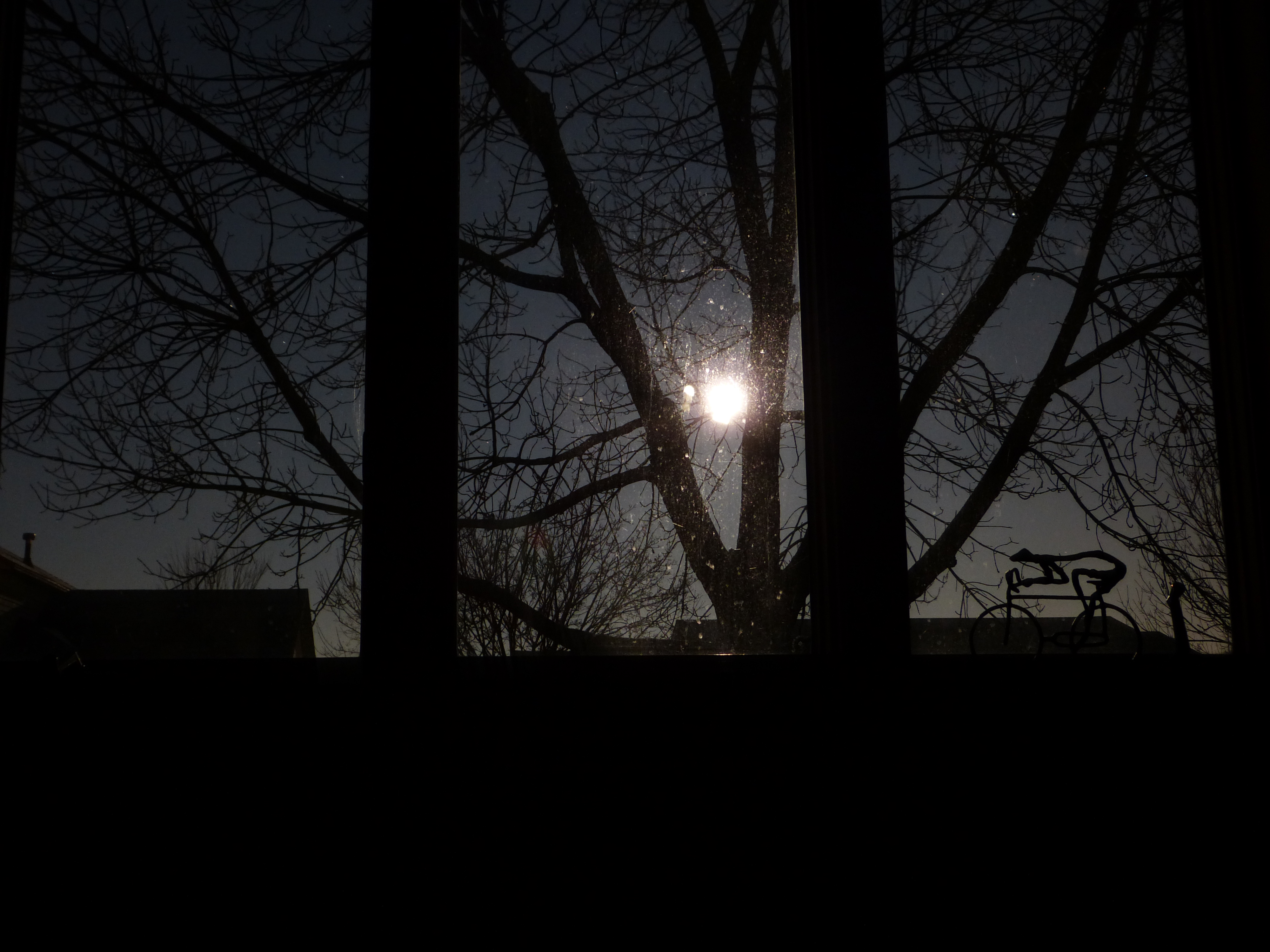
It got cold in Minnesota, which we all knew was going to happen, but never thought it would take this long. I woke up to find it was -10°, with a wind chill of -27°. As such, many of us now have ice indoors. As pictured. To clarify, dirty window on top, condensation, ridge of ice on the INSIDE of the window, and at bottom the wooden sill preparing to harbor mildew when said ice melts. On the upside, the temp has risen to -3°, and I usually take the interior frost to mean that the humidity levels inside are okay. Just thought I’d share that for those of you who don’t get to enjoy the full splendor of winter. If we ever get snow, maybe I’ll share that too, but since nearly every place in the nation EXCEPT us has gotten whacked with a snowstorm this year, maybe not.


Distracting Thing  3

Older son got his driver’s license yesterday. I waver between punctuating that with an exclamation point and a teardrop. Yes, very good that he is achieving milestones (landmines? I wonder why that word wants to slip in there?) Very good that he can help out with running errands and stretch his wings and prepare for life as an adult. Very sad that he and his younger brother continue to slip out of my arms and into the world. Very scary that they are increasingly exposed to important and dangerous situations with insufficiently developed brains and decision-making skills. Some people handle this time of parenting with grace. It is taking everything I’ve got to maintain my balance, and it isn’t pretty. Sometimes as a parent, I still feel like the kid in the classroom, wondering what I missed. Caffeine only helps so much, and it is cold out here. I guess the trick is to remember I am not in this alone, and to keep looking forward while I balance the best I can, because this ride isn’t over yet. Thank you for hanging in there with me.